Parivarik ManuRanjan (2026): Pankaj Tripathi Anchors A Mansion Of Missed Opportunities
Pankaj Tripathi returns to the domestic comedy register, this time as a forty-year-old bachelor rattled by a house manager who refuses to stay ornamental. Varun V. Sharma’s Sony LIV original wants to be a quiet chamber piece about companionship; it settles, too often, for the safest room in the house.
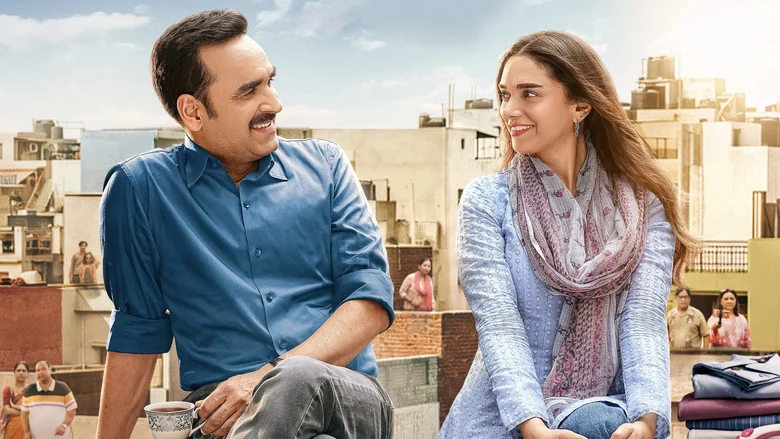
A Bachelor’s Routine Is Not Yet A Dramatic Engine
The opening stretch plants us inside Ranjan Dubey’s Lucknow ancestral mansion, where he has arranged his solitude into something resembling peace. Brijendra Kala’s well-wisher bustles through a matchmaking attempt that collapses before it begins, and the film treats the failure as gentle comedy rather than a wound.
That choice is legible, but it costs the narrative its propulsion. When Aditi Rao Hydari’s Helen arrives from Delhi to manage the property, the screenplay leans on the simple shock of discovering an unmarried man living alone in a house built for generations.
Sharma, working from a script he developed with Kala and Ali Abbas Zafar, stages the arrival with a light touch that borders on weightlessness.
The mansion is expansive, the camera holds it at a polite distance, and the emptiness of the frame becomes the film’s most honest statement about Ranjan before Helen’s arrival rearranges it.
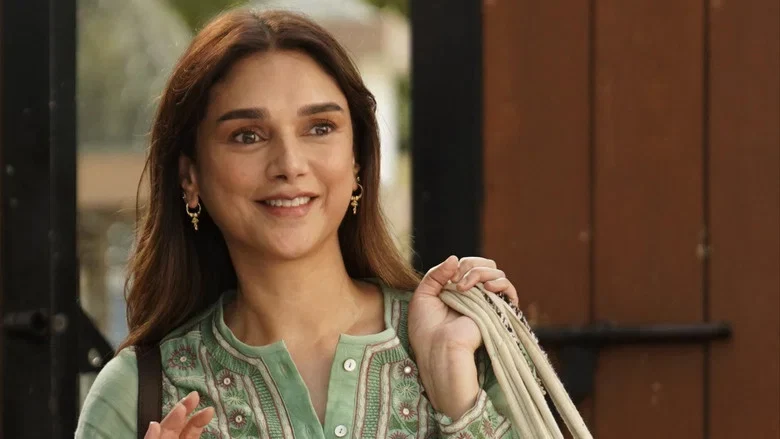
Forced Proximity Without A Sharper Social Reckoning
The romantic-comedy mechanism here is proximity, not pursuit. Helen moves through the house with professional purpose, and Ranjan orbits her with the awkward courtesy of a man who has forgotten how to share a kitchen, a corridor, a routine.
Where the film could sharpen its edge is the employer–employee arrangement itself. The script gestures at the imbalance, then retreats into coy domestic comedy, as though naming the problem would spoil the mood. Social prejudice is the stated antagonist, but it arrives as a murmur rather than a confrontation.
There is a version of this story that interrogates the class friction head-on, and it would have given the second half a spine. What we get instead is a series of pleasant exchanges that rarely escalate into genuine stakes.
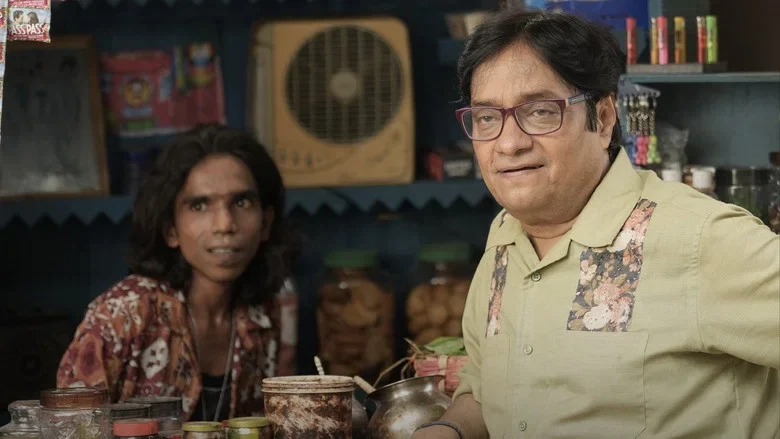
Tripathi’s Stillness And Hydari’s Guarded Warmth
Tripathi’s Ranjan is built from small physical deferrals: the half-step back when Helen enters a room, the way he holds a teacup as if it were a diplomatic object, the pause before he answers a question about marriage.
He plays the bachelor not as a comic eccentric but as a man who has confused routine with contentment.
Hydari’s Helen carries the film’s perspective on independence. She arrives with a functional brief, and her performance keeps a professional guard up even as the domestic intimacy deepens, which makes the character’s agency legible without speeches.
The pairing works best in the unspoken moments, when the two share a frame and the camera lets them sit in silence. Those beats carry more weight than most of the dialogue, and they expose how thin the surrounding material can be.
Kala’s well-wisher is the bridge between Ranjan’s private world and the surrounding community, and his scenes have a lived-in texture that the central romance sometimes lacks. The remaining supporting roles register as social texture rather than dramatic function, and the film rarely gives them enough to do beyond observing.
Where The Tone Softens What Should Cut
Sharma’s direction favors observation over escalation. The mansion’s interiors are lit warmly, the camera stays medium-wide, and the film’s rhythm is deliberately unhurried, which suits the material until the story needs to press harder on the prejudice theme.
That is where the film’s restraint becomes a liability. A romantic comedy can coast on charm, but a family drama about social judgment needs a moment where the charm stops working, and Parivarik ManuRanjan keeps reaching for the softer register.
The comparison to the tonal discipline of Ramayana is instructive only by contrast: that film understood that restraint must eventually give way to consequence, and here the consequence feels deferred.
Tripathi’s recent work has shown a willingness to sit inside discomfort, and the psychological weight he brought to Mirzapur is largely absent from this gentler register. The film asks him to be likable, and he is, but likability is not the same as dramatic pressure.
The Streaming Calculus And A Star’s Comic Leverage
Bhanushali Productions and AAZ Films are steering this one straight to Sony LIV, bypassing the theatrical circuit entirely, which tells you something about how the producers are reading the market for mid-budget Hindi relationship comedies.
The direct-to-OTT route makes commercial sense for a contained, performance-led film with no spectacle to sell, but it also removes the box-office pressure that might have forced a sharper third act. The franchise logic here is star-driven rather than IP-driven, and Tripathi’s streaming pull is the real asset on the balance sheet.
For a film like this, the theatrical lifecycle question is moot, but the broader question of whether Hindi comedies can sustain themselves on charm alone is not. The genre is crowded, and Pehla Pyaar Doosri Baar recently demonstrated how quickly a reunion rom-com can fumble its own premise when the writing runs out of gears.
What Parivarik ManuRanjan has going for it is the novelty of its central pairing and the specificity of its Lucknow mansion setting. What it lacks is the narrative friction that would make that setting feel like a pressure cooker rather than a backdrop.
A Quiet Film That Needed One Loud Scene
The ending gestures toward companionship and family acceptance, and the film’s heart is clearly in the right place. But a story about resisting social prejudice needs at least one moment where the prejudice draws blood, and this one keeps the wound off-screen.
What lingers is Tripathi’s face in the quiet moments, a man slowly realizing that solitude was a habit rather than a choice. That is a real performance in search of a sharper film, and it leaves Parivarik ManuRanjan as a gentle, well-acted sketch of a movie that never quite commits to its own argument.
For viewers drawn to contemporary Hindi comedies that prioritize character over plot, there is enough here to justify an evening. Just do not expect the mansion to shake.

Ankit Jaiswal is the Chief Author, covering Indian cinema and OTT releases with honest, no-filler criticism. An SEO strategist by background, he brings a research-driven approach to film writing, cutting through hype to tell you exactly what's worth your time.