Udta Teer (2026): Ayushmann Khurrana’s Amnesiac Spy Comedy Chooses Laughs Over Logic
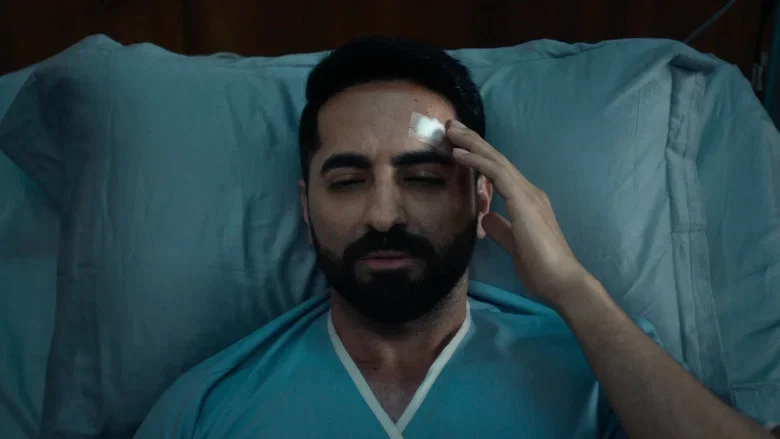
A Pakistani spy wakes up convinced he is an Indian counter-terrorism officer, and the film that follows treats that identity fracture as a joke machine rather than a psychological wound.
Ayushmann Khurrana throws himself into the split with visible relish, but Aakash Kaushik’s directorial debut keeps mistaking volume for voltage.
A Comic Premise That Refuses To Interrogate Its Own Terror
The setup is genuinely seductive: Bilal, a Pakistani operative, loses his memory and reconstructs himself as Vikrant, a patriot hunting the very people he once served.
Kaushik understands the dramatic irony baked into that gap, the audience knows the truth the hero cannot access, and every salute he throws lands with a double edge.
Yet the screenplay treats that irony as a punchline generator rather than a moral trap. The espionage architecture exists only to create misunderstandings, not consequences.
When Bilal’s fragmented memory threatens to surface, the film reaches for a comic beat instead of a reckoning, and the air goes out of the room.
The comparison to other recent theatrical misfires is instructive. Just as the identity chaos in The Brandos never cohered into dramatic stakes, this film’s central conceit keeps spinning without ever landing a decisive blow.
Khurrana’s Physical Comedy Cannot Mask The Missing Interior Life
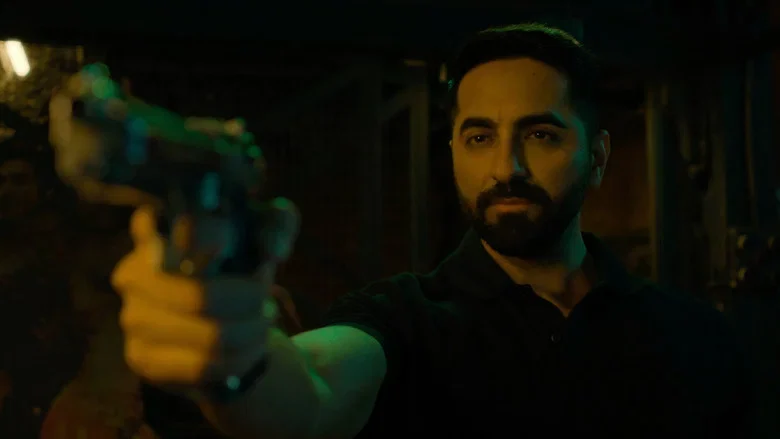
Khurrana is the reason to stay. Watch his shoulders in the mission-control sequences, squared like a soldier’s, then collapsing into a civilian slouch the moment a superior turns away.
His eyes do a rapid recalculation every time someone addresses him as Vikrant, and that flicker of doubt is the film’s most honest special effect.
But the performance is asked to carry a character who never truly confronts what it means to be a man without a country. The script gives him panic and confidence, never conscience.
That gap echoes the same trap that swallowed the lead in Pati Patni Aur Woh Do, charm deployed as a substitute for character, and a star asked to coast on likability rather than revelation.
Sara Ali Khan’s Yamini exists in the film’s fog of concealed loyalties, but the screenplay never grants her a scene that clarifies whether she is ally, handler, or threat.
She plays the ambiguity with a cool, watchful stillness, but the film keeps her at the edge of the frame when she should be the pressure point.
Villains Reduced To Costume And Cadence
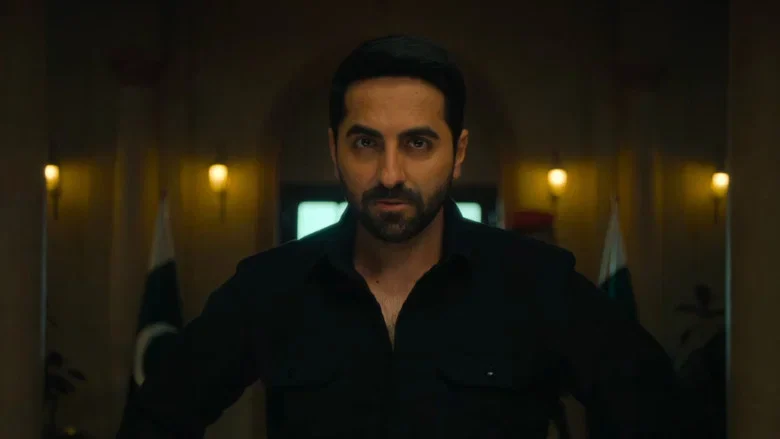
Mukul Dev’s Azhar Maqsood arrives with the weight of a recognizable real-world reference, yet the film gives him menace without method, a scowl, a prayer bead, a threat delivered from a distance.
Gulshan Grover’s General Mir similarly functions as a uniform rather than a person, a command presence with no operational logic behind his orders.
Rahul Bose brings a welcome severity to Burman, and in one interrogation scene his refusal to blink while Khurrana rambles is the closest the film comes to genuine tension.
But the supporting ensemble is largely asked to react rather than act, their faces registering confusion so the audience can feel superior to the chaos.
Kaushik’s Direction Finds Rhythm But Loses Rigor
Kaushik has an instinct for pace. The film moves, the cuts land on the beat, and the comic timing in the first hour is sharper than the material deserves.
What he lacks is discipline over tone, the action sequences are staged with a straight face while the dialogue undermines them, and the mismatch creates neither thrill nor farce.
The cinematography favors a flat, brightly lit procedural look that makes the intelligence bunkers feel like conference rooms. There is no visual language for paranoia.
By the time the climax arrives, the film has spent so much energy on confusion that it has none left for catharsis, and the resolution lands with a shrug rather than a shock.
The genre has been here before. The same exhaustion that drained the momentum from Dhamaal 4 creeps into this film’s final act, where the jokes keep coming but the stakes have long since evaporated.
Dharma And Sikhya Bet On A Star Vehicle Without A Steering Wheel
Dharma Productions and Sikhya Entertainment have assembled a prestige-adjacent package here, a debut director, a bankable lead, and a premise that could have been a sharp satire of patriotism as performance.
Instead, the film plays it safe, and the commercial math reflects that caution. Advance bookings have been described as lukewarm, and the social-media conversation has been muted.
For Khurrana, this represents a familiar risk: his box-office leverage depends on scripts that let him be vulnerable rather than merely clever. This one asks for the latter and never earns the former.
For the Hindi spy comedy as a whole, the lesson is blunter, audiences will forgive implausibility if the emotion is real, but they will not forgive a film that mistakes confusion for complexity.
Across contemporary Hindi comedy, the pattern is becoming hard to ignore: star charisma is being used to paper over structural hollows, and the returns are diminishing.
The Final Verdict
Udta Teer is not a disaster. It is a near-miss with a genuinely interesting idea at its center, undone by a screenplay that never decides whether it wants to be a farce or a thriller.
Khurrana’s performance deserves a better film, and the audience deserves a spy comedy that trusts them to feel the vertigo of a man who cannot trust his own memories.
What lingers is not the laughter but the missed opportunity, a film about a man who forgot who he was, made by filmmakers who never quite decided who he should be.

Ankit Jaiswal is the Chief Author, covering Indian cinema and OTT releases with honest, no-filler criticism. An SEO strategist by background, he brings a research-driven approach to film writing, cutting through hype to tell you exactly what's worth your time.