Dilwali Diwali (2026): Mihir Ahuja Anchors a Muted Festival of Displacement
The high-rise apartment sits empty, its marble floors reflecting a family that refuses to occupy them. Ritesh Menon’s Netflix drama opens on this precise image of filial triumph turned hollow, and for a while, the stillness cuts deep.
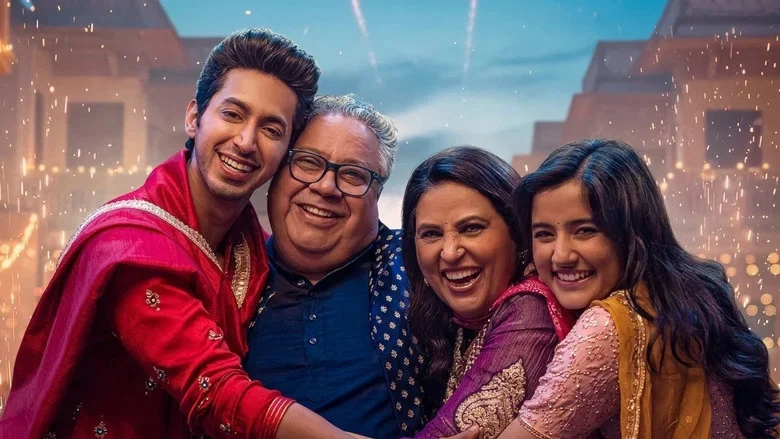
A Son Returns With A Key, Not A Home
Ansh Sikkha (Mihir Ahuja) has spent years abroad and come back to Punjab carrying the deed to a modern flat. He presents it to his middle-class parents as proof of success, a material answer to years of sacrifice.
But the film’s central friction is not whether they will accept the gift. It is whether a new address can ever replace the emotional geography of the home they already know, and Menon stages this tension with documentary patience.
The Diwali gathering becomes the pressure cooker. Relatives arrive with opinions about class mobility and duty, and the apartment becomes a battleground for competing definitions of a life well-lived.
Where The Script Breathes, And Where It Suffocates
The screenplay’s smartest move is keeping the conflict internal. There is no villain, no property dispute, no external threat to unify the family against. Just the slow, awkward reality of people who love each other but cannot agree on what love should look like.
That choice also exposes the film’s central weakness: without an external engine, the middle stretch relies entirely on the actors to sustain tension through conversation alone. When the writing runs thin, the silences start to feel less like restraint and more like stalling.
Menon’s direction favours long takes in the family living room, the camera refusing to cut away from awkward glances. This mirrors the emotional claustrophobia, but it also flattens the momentum in the second act, where the same argument gets reheated in slightly different words.
Mihir Ahuja’s Restraint, And The Weight Of What He Withholds
Ahuja plays Ansh as a man perpetually on the verge of explaining himself, then deciding not to. His jaw tightens when his father dismisses the apartment, but he never raises his voice. The performance lives in the gap between what he wants to say and what he actually offers.
That kind of controlled frustration is harder than it looks. Where a lesser actor would reach for a tearful confrontation, Ahuja keeps the hurt behind his eyes, letting his mother’s casual dismissal of the balcony view land like a slap he refuses to acknowledge.
Manoj Pahwa, as the family patriarch, does the opposite. He fills the room with small, physical objections, adjusting his shawl, clearing his throat, reaching for another laddu, and each gesture registers as a quiet veto of his son’s grand gesture.
Neelu Kohli, meanwhile, carries the film’s most complicated emotional beat without saying much at all. Her character’s loyalty is split between her son’s ambition and her husband’s rootedness, and Kohli plays that division in the way she keeps her hands busy, folding napkins that no one will use.
When The Camera Refuses To Leave The Room
The film’s visual grammar is deliberately unshowy. Menon and his cinematographer favour natural light and mid-range shots that keep the family unit framed together, even when they are arguing. The apartment’s sleek surfaces contrast with the old home’s cluttered warmth, but the camera never underlines that contrast with a heavy-handed cut.
The sound design is similarly restrained, with the Diwali celebrations happening off-screen for most of the runtime. The crackle of firecrackers becomes a distant reminder that the world outside is celebrating while this family quietly fractures.
If there is a technical misstep, it is the pacing of the final act. The reconciliation arrives with a softness that feels earned emotionally but underwhelming dramatically, as if the film is afraid to let its characters fully confront the damage they have done to each other.
A Familiar Festival Of Feelings, Slightly Underbaked
The film’s closest thematic sibling is Pyre, another contemporary Hindi drama about rural abandonment and the quiet devastation of family expectations. Both films trust silence over speeches, and both understand that the most painful conversations are the ones that never happen.
But where Pyre had the weight of its setting pressing down on every frame, Dilwali Diwali feels lighter, more tentative. The Diwali backdrop offers warmth and colour, but it also softens the edges of what could have been a sharper critique of class aspiration and expatriate guilt.
There is a version of this story that interrogates Ansh’s need to prove himself more ruthlessly. This version, for all its emotional intelligence, lets him off the hook in the final stretch, offering reconciliation before the harder questions have been fully asked.
The Streaming Debut That Won’t Break The Internet
As a Netflix release, Dilwali Diwali arrives without the commercial pressure of a theatrical box office, which is both a blessing and a limitation. The streaming giant has been investing heavily in mid-budget Hindi family dramas, and this one fits neatly into that slate without pushing any boundaries.
For Mihir Ahuja, this is a solid showcase of his range after more commercial outings. The film gives him space to play quiet rather than charming, and that shift is worth noting for anyone tracking his career trajectory.
But the film’s commercial ceiling is clear. It is a festival-season family drama designed for living-room viewing, not a conversation-starter. It will find its audience among viewers who want gentle, recognisable emotional terrain, but it will not create the kind of cultural ripple that defines a breakout hit.
For Ritesh Menon, the film demonstrates a steady hand with actors and a genuine feel for domestic spaces. What it lacks is the narrative ruthlessness to push its characters into genuinely uncomfortable territory, the kind of risk-taking that would make the resolution feel less like a foregone conclusion.
The Apartment Is Empty, And So Is The Promise
By the end, Ansh has learned what the audience suspected from the first frame: a home is not a floor plan. The film’s final image returns to the high-rise balcony, but the emotional weight has shifted, and that shift is the film’s quietest achievement.
Dilwali Diwali does not reinvent the family drama, but it understands the specific ache of loving people who cannot accept the version of care you are offering. That ache is real, and the film captures it in scattered, unguarded moments.
What lingers is not the argument or the reconciliation, but the image of a mother folding napkins in a room full of people who no longer know how to talk to each other.
It is a small, devastating picture of what prosperity can and cannot buy, and it is the reason this film is worth your time, even when it leaves you wanting more.
This stylistic discipline reflects a welcome evolution across contemporary hindi dramas, prioritizing character conviction over easy commercial formulas.

Ankit Jaiswal is the Chief Author, covering Indian cinema and OTT releases with honest, no-filler criticism. An SEO strategist by background, he brings a research-driven approach to film writing, cutting through hype to tell you exactly what's worth your time.