Drones (2026): Dravid Selvam Anchors a Madcap Horror-Comedy With a Point Worth Making
R. Raghav Mirdath’s Drones opens on a hijacked house drone drifting toward an old mansion window, and the film never quite recovers from the seduction of that image. What follows is a Tamil surrealist fantasy that wants to be a witch story, a campus comedy, a romance, and a lecture on beauty standards all at once.
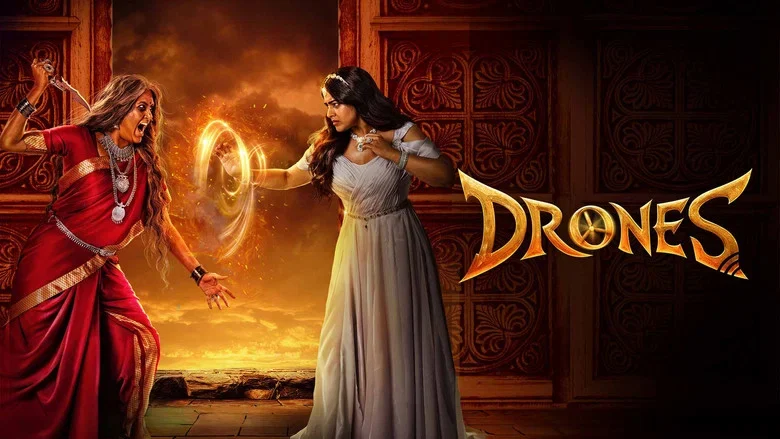
A Drone, a Witch, and a Lesson Wearing a Costume
The premise is genuinely irresistible: astrophysics student Kish (Dravid Selvam) and his friends Rush (Anjali Nair) and Dush (RJ Deepak) get suspended, take refuge in a mad scientist’s locked-down house nicknamed the Black Hole, and use the household drone, Sampangi, to spy on a mysterious mansion across town.
What the drone finds is Prakruthi (Siddhi Idnani), a miniature artist whose beauty triggers instant, ritualised obsession in every man who sees her. Mirdath stages this discovery as a technological intrusion into a storybook world, and for twenty minutes the film hums with promise.
The trouble is that Mirdath keeps adding mechanisms without deciding which one drives the plot. Padmanaban (Mohamed Kuraishi) is building a made-to-order girlfriend, a witch (Devadarshini) lurks in the mansion, and a bride-hunting Inspector (Cinemawala Sathish) is cursed so that any woman he sincerely tells “I love you” will die. Each is a wonderful idea. Together, they compete for oxygen.
When Repetition Becomes the Joke and Then the Problem
The film’s comic engine is a repeated courtship ritual: men arrive at Prakruthi’s door with poems, dolls, and rings, pledging to love her even when her hair turns white. The first time, it’s funny. The third time, it’s a pattern. By the sixth, the viewer is doing the math on how much repetition the film believes it can sustain.
What the script never quite solves is why Kish remains oblivious to Rush’s years of quiet devotion while chasing a woman he has only seen through a lens. That blindness is the point, but the screenplay treats it as a given rather than a wound. The love triangle has stakes on paper and inertia on screen.
Mirdath’s instinct for staging props over dialogue is the film’s saving grace, the dolls and rings do more thematic work than most of the exposition. It’s a scrappier, more chaotic approach than the controlled whimsy of Poniiy, which at least knew which story it was telling.
The Confrontation That Justifies the Whole Enterprise
Then Rush confronts the witch, and for five minutes Drones becomes the film it should have been all along. Anjali Nair plays the scene with a clenched stillness, shoulders squared, voice low, no tears, as she tells the witch that society’s narrow definition of beauty causes real, measurable hurt.
Devadarshini is the film’s most valuable performer, shifting between comic menace and wounded authority without a visible seam. When she tilts her head and lets a beat of silence sit before responding, the horror and the satire finally occupy the same frame.
Selvam’s Kish is the weaker anchor, mostly because the role asks him to be a vessel for the film’s thesis rather than a character with an arc. His best moments are reactive, the slack-jawed stare through the drone feed, the small flinch when Rush says something true, and they recall the restrained grief he carried through Once More.
Genre Machinery That Almost Holds Together
The spatial logic is smarter than the plotting: the Black Hole’s sterile confinement versus the mansion’s warm, cluttered fairy-tale texture creates a visual argument about science versus story, surveillance versus intimacy. The drone’s remote gaze does more thematic work than any dialogue about appearances.
But the middle stretch sags under the weight of its own eccentricity. Padmanaban’s experiments, the Inspector’s romantic curse, and the doll transformations all compete for screen time without a clear narrative exit. The film knows how to enter its fantasy world; it doesn’t always know how to leave it.
Where the film’s tonal balancing act holds, it’s because Mirdath refuses the kinetic sensationalism that swallowed Indian Institute of Zombies, opting instead for a looser, more playful register that suits the material. It’s a scruffier proposition than most of what passes for contemporary Tamil horrors, messier, but also more willing to have an actual argument.
What GM Morgan Films Is Betting On
GM Morgan Films is producing an unproven director with an unproven lead, betting that the genre-blend novelty can carry the marketing. That’s a riskier wager than it looks in a market where Tamil horror-comedies have become a reliable pipeline but rarely a breakout one.
Selvam’s box-office leverage remains modest; he’s a credible actor without a proven opening. The film’s commercial fate will likely rest on word-of-mouth from audiences drawn to the drone-and-witch premise rather than any star pull, which makes the muddled middle stretch a genuine financial liability.
The Verdict: A Heart in Search of a Skeleton
Drones means well, and its final argument, that love should respond to character rather than appearance, lands with real force in Rush’s confrontation. But a film cannot survive on one great scene and a handful of charming props.
Mirdath has the instincts of a genuine fantasist and the discipline of a first-time filmmaker still learning which ideas to cut. The witch, the drone, and the miniature artist deserve a tighter film than the one that surrounds them.
What lingers is Anjali Nair’s clenched jaw and Devadarshini’s tilted head, two performers doing the emotional labour the screenplay couldn’t quite structure. Drones is a calling card, not a finished argument, and its best moments suggest the director’s next film will be the one worth waiting for.

Ankit Jaiswal is the Chief Author, covering Indian cinema and OTT releases with honest, no-filler criticism. An SEO strategist by background, he brings a research-driven approach to film writing, cutting through hype to tell you exactly what's worth your time.