Meethe Mein Kya Hai (2026): Ritwik Bhowmik Anchors a Diwali Reunion That Bites Before It Comforts
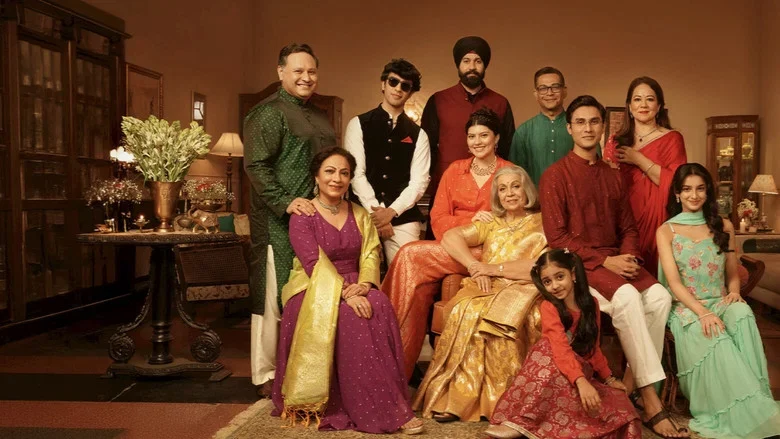
The first thing Radhika Bansal’s camera finds in Nani’s Lucknow house is a doorway too narrow for the number of people pushing through it. Diwali has arrived, and so has Jai, a young widower who would rather be anywhere else.
A Grieving Man Walks Into a Festival He Cannot Refuse
Ritwik Bhowmik plays Jai with the specific exhaustion of someone performing wellness for relatives who keep asking if he’s eating. The premise is simple and loaded: a widower returns to his maternal grandmother’s home for the festival, carrying a loss the household refuses to name.
Bansal stages the arrival as a gauntlet of aunts, marigold garlands, and overlapping questions. The film understands that grief in an Indian joint family is never private, it is negotiated, catered, and loudly mismanaged.
The Surprise Marriage Announcement Is the Film’s Real Firecracker
Just as the household settles into festive routine, Jai’s sister announces a marriage nobody sanctioned. The Diwali gathering flips from celebration to tribunal, and every relative with an opinion suddenly has a microphone.
This is where the screenplay does its sharpest work. The marriage dispute isn’t a plot device bolted onto grief; it’s the pressure valve that forces the family to argue about choice, duty, and who gets to decide what a daughter owes her elders.
The ensemble sprawls across generations without turning into a checklist, and the film’s containment inside one house gives the arguments a claustrophobic momentum. It’s a structural gambit that recalls the single-location intimacy of Little Thomas, another recent Hindi drama that trusted a confined setting to do the emotional heavy lifting.
Rohini Hattangadi Holds the House Together With a Look
Rohini Hattangadi’s Nani is the film’s quiet architecture. She doesn’t raise her voice when the shouting starts; she simply lowers her teacup, and the room recalibrates. It’s a performance built on stillness and timing, and it gives the chaos a gravitational center.
Ayesha Raza’s Amrita operates in a different register entirely, all nervous hospitality and strategic silence, the kind of woman who refills your plate instead of answering your question. The two actresses share a kitchen scene where neither says what they mean, and it’s the most electric sequence in the film.
Bhowmik, meanwhile, resists the temptation to play grief as visible suffering. His Jai is a man who has learned to fold himself into corners, and the performance earns its emotional release by withholding it for most of the runtime.
The restraint echoes the unshowy discipline of Doosra, where interiority was carried through posture and pause rather than dialogue.
Bansal’s Camera Chooses Clutter Over Composition
The director’s visual strategy is deliberate disarray. Cinematographer’s frames are crowded with fairy lights, drying clothes, and relatives who won’t leave the shot, the camera is constantly being blocked by the family, which is precisely the point.
When the film finally grants Jai a moment alone, the frame opens up and the silence lands like a physical weight. It’s a simple contrast, but it’s deployed with real discipline, and it makes the climactic reconciliation feel earned rather than engineered.
The music stays mostly diegetic, a devotional song here, a Bollywood number leaking from a neighbor’s speaker there, which keeps the emotional temperature honest. The film resists the swelling score that would have turned the final act into a greeting card.
Where the Reunion Drama Loses Its Nerve
For all its sharp observation, the second half softens in ways that feel like a different film. The secrets that surface are resolved with a speed that betrays the patient buildup, and a few characters who were vividly drawn in the first hour become background furniture by the end.
The film’s instinct to comfort ultimately undercuts its own inquiry. It asks hard questions about grief, autonomy, and generational debt, then answers them with a group hug and a plate of mithai. The tonal sibling here is Sumo Didi, another recent Hindi drama that built genuine tension before retreating into uplift.
Netflix Gets a Festival Film That Belongs in Theaters
The direct-to-Netflix release is the film’s commercial reality, and it’s a strange fit. This is a Diwali movie, the kind of family drama that plays best in a packed hall where the audience laughs and sniffles together. On a laptop, the overlapping voices and crowded frames lose some of their communal charge.
For Netflix, the film slots neatly into a growing slate of festival-set family dramas aimed at diaspora viewers and urban multiplex audiences who’ve migrated to streaming. For Bansal, it’s a confident debut that announces a director with a genuine feel for domestic texture and ensemble rhythm.
Bhowmik, coming off the musical charisma of Bandish Bandits, proves he can carry a quieter, more interior role. Whether that translates into theatrical leverage is a question the streaming model can’t answer, but it’s the kind of performance that builds a career rather than a weekend gross.
The broader landscape of contemporary Hindi dramas is increasingly split between theatrical spectacle and streaming intimacy, and this film sits firmly in the latter camp, well-made, well-acted, and slightly too eager to please.
A Festival Film That Forgets the Fireworks Are Loudest Before They Fade
Meethe Mein Kya Hai is at its best when it lets its family argue, messy, overlapping, unresolved. The Diwali setting isn’t decoration; it’s a pressure cooker, and Bansal knows how to keep the lid rattling.
But the film’s final movement trades confrontation for catharsis, and the trade feels too easy. Jai’s grief is acknowledged, the marriage is blessed, and the household returns to its festive hum.
What lingers is not the reconciliation but the arguments that preceded it, the sharp, funny, uncomfortable truth that families are hardest to love when they’re trying their best.
Bansal has made a film about the noise a family makes while pretending everything is fine. The tragedy is that she ultimately believes them.

Ankit Jaiswal is the Chief Author, covering Indian cinema and OTT releases with honest, no-filler criticism. An SEO strategist by background, he brings a research-driven approach to film writing, cutting through hype to tell you exactly what's worth your time.