Dhood (Sandstorm) (2026): Yashpal Sharma Anchors a Thar Desert Pressure Cooker That Refuses Easy Answers
The sand does not move in Anand Singh Chouhan’s opening frames. It sits, pale and indifferent, behind a household already cracking at the seams.
This is a Rajasthani psychological thriller that trusts silence more than shouting, and it announces a filmmaker who understands that isolation is a dramatic instrument, not a backdrop.
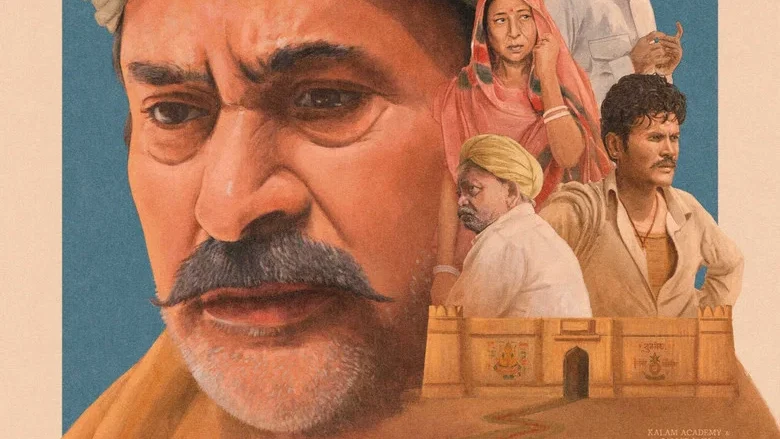
A Lineage Crisis That Turns the Family Home Into a Pressure Chamber
Set in the early 1990s, the film plants us inside an isolated family compound in the Thar Desert where inheritance, authority and old obligations have calcified into something suffocating.
Chouhan wastes little time on exposition. The household’s rules are established through posture and placement, who sits, who serves, who is permitted to speak first.
The central engine is greed colliding with the demand to preserve the family name, and the screenplay treats these as the same disease wearing different clothes.
What distinguishes this from the kinetic sensationalism that overtook Gajab Raat is patience. The film withholds its reversals, letting domestic friction do the work that a lesser thriller would hand to a plot device.
Yashpal Sharma’s Stillness Becomes the Film’s Loudest Instrument
Yashpal Sharma anchors the ensemble with a performance built almost entirely from restraint, a lowered gaze here, a hand resting too long on a doorframe there.
His authority figure never raises his voice in the first hour, and that refusal is precisely what makes him frightening. The threat lives in what he declines to say.
It recalls the psychological weight he carried in Licence, though here the register is quieter, more coiled, less reliant on external conflict to justify his presence.
Alka Amin matches him in the domestic register, her silences carrying a different texture, resignation edged with calculation. The two share frames without ever quite sharing the same emotional room.
The supporting ensemble of debuting performers is deployed as texture rather than characterization. They hover at the edges of the compound, and the film seems deliberately uninterested in granting them interiority.
The Desert as Confinement, Not Spectacle
Cinematographically, the film resists the postcard temptation of the Thar. The camera stays low and close, framing bodies against walls rather than against horizons.
Wide shots are rationed. When they arrive, they emphasize distance from any outside intervention, a useful foundation for psychological confinement rather than visual tourism.
Mehul Surti’s score is used sparingly, often dropping out entirely during confrontations. The absence of musical cueing during the film’s tensest exchanges forces the audience to sit in the discomfort.
Where the film stumbles is in its middle stretch, where the domestic countdown loses some of its early precision. The escalation becomes repetitive, circling the same fractures without deepening them.
This is a tonal gamble that echoes the ambitions of Pehla Pyaar Doosri Baar, another recent release that trusted mood over momentum, and paid a price for it.
A Pan-India Bet on Regional Identity and the Studio’s Commercial Calculus
Soul of Desert Production, in collaboration with Ainak Co-Labs and presented by Kalam Academy and Samar Jain, is making a calculated wager here.
The film’s status as a planned pan-India theatrical release for a Rajasthani-language feature is the real commercial story, a test of whether regional identity can travel beyond its linguistic base.
For Sharma, this represents a different kind of leverage than his mainstream work. His theatrical draw here depends not on star wattage but on the credibility of a character-led ensemble.
The producing banners are betting that audiences across contemporary Hindi thrillers and regional cinema are hungry for something that does not announce its intentions loudly.
Whether that bet pays off depends on word-of-mouth from viewers willing to sit with a film that refuses to explain itself.
The Uncomfortable Resolution and What It Leaves Behind
The climax does not offer catharsis. It offers consequence, the quiet, grinding kind that follows decisions made under pressure and then buried.
What lingers is not a twist but a question about whether preserving a lineage was ever worth the cost the family paid to protect it.
Dhood is not a film that flatters its audience. It asks for patience, and it rewards that patience with a portrait of kinship as a slow-acting poison.
Chouhan has made something that feels less like a thriller and more like an autopsy performed while the patient is still breathing.

Ankit Jaiswal is the Chief Author, covering Indian cinema and OTT releases with honest, no-filler criticism. An SEO strategist by background, he brings a research-driven approach to film writing, cutting through hype to tell you exactly what's worth your time.