Ramayana: Rise of a Legend (2026): Ranbir Kapoor’s Divine Restraint Meets Yash’s Ferocious Gravity
The first image is not of a god, but of a ledger being balanced in blood. Nitesh Tiwari opens his adaptation not with a hymn, but with a political grievance.
Ravana, before he is a demon king, is a liberator. That choice is either the film’s grandest ambition or its most dangerous miscalculation.
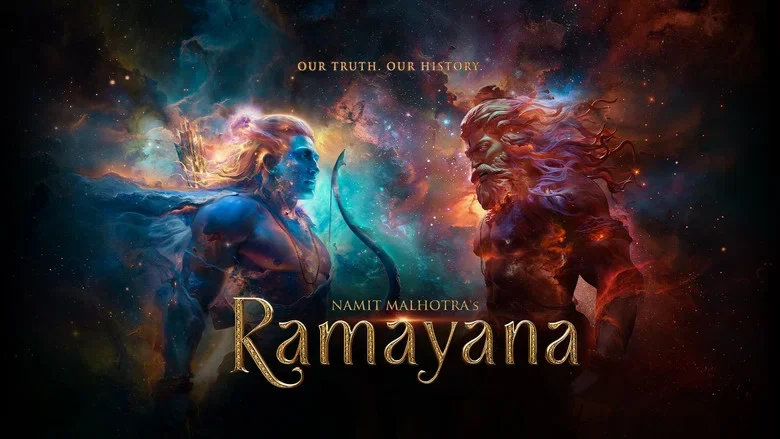
When A Villain Is Given A Grievance, The Gods Must Earn Their Light
The film’s first act belongs entirely to the Asura. Yash’s Ravana is introduced in the act of prayer, not for domination, but for the power to free his enslaved clan from Deva rule.
It is a startling inversion. The screenplay frames Lanka’s subjugation as a political fact, and Ravana’s rage as a comprehensible response to it.
But there is a cost to this sophistication. By the time Vishnu responds by incarnating as Rama, the film has spent so much oxygen on the antagonist’s ideological origin that the divine side feels like a structural obligation rather than a dramatic ignition.
Tiwari, who has previously examined abandonment with such restraint in Pyre, applies a similar patience here to Ravana’s political awakening. The problem is that the film only has so much patience to distribute.
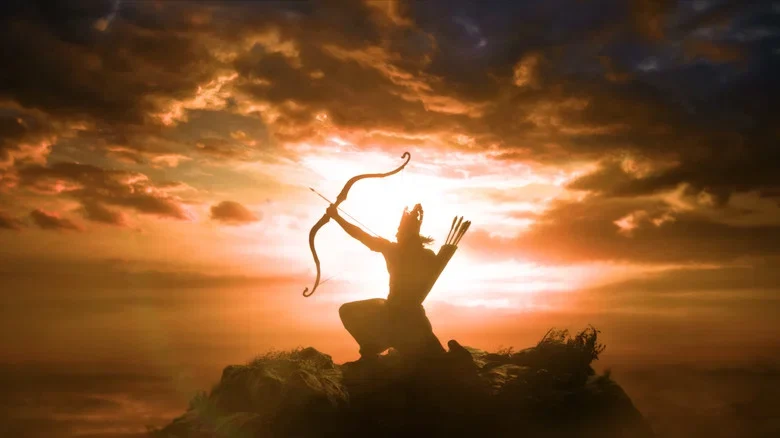
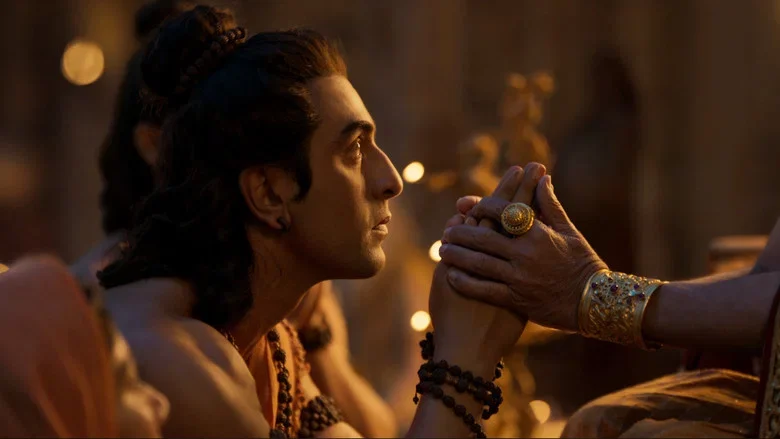
Ranbir Kapoor Plays A Prince Who Has Not Yet Become A God
Kapoor’s Rama is defined by what he withholds. In the Ayodhya sequences, he moves through the palace with a stillness that reads as obedience rather than passivity, his shoulders squared, his gaze fixed slightly above the eyeline of whoever is addressing him.
It is a performance of restraint, and it works precisely because Kapoor resists the urge to play divinity. There is no glow, no preternatural calm. Just a son who has been told what duty requires.
The marriage sequence with Sai Pallavi’s Sita is the film’s most tactile passage. Pallavi plays Sita with a quiet, watchful intelligence, her hands often folded, her eyes tracking Rama’s face for cues he does not give.
The exile announcement lands not as a grand betrayal but as a domestic fracture. The camera stays close on Kapoor’s face as he receives the news, and his reaction is a single, almost imperceptible exhale.
It is the kind of micro-gesture that recalls the physical exhaustion of a different kind of performance entirely, the gangster’s hollowed-out authority in Toxic. Both actors understand that power is most legible in the moment it is asked to surrender.
Yash Builds A Tyrant From The Inside Out, And The Screen Bends Around Him
The film’s visual grammar shifts whenever Yash enters a frame. The camera drops lower, the lighting hardens, and the score, Hans Zimmer and A.R. Rahman working in tandem, thins to a single, sustained note.
His Ravana is not theatrical. There is no booming laughter, no exaggerated menace. Yash plays him as a man who has already won every argument he has ever had.
In the prayer sequence, his voice is low enough that the viewer leans forward to catch it. His hands tremble slightly as he invokes the power he seeks, and that tremble is the only sign that he is asking for something he does not yet possess.
By the time he becomes a conqueror, the trembling is gone. He sits on his throne with one leg crossed over the other, his chin resting on his knuckles, watching his siblings plan attacks with the detached air of a man reviewing a ledger.
It is a performance of accumulating weight rather than escalating volume. And it exposes the film’s central imbalance: whenever Yash is off-screen, the film feels like it is waiting for him to return.
The Two-Part Structure Is A Promise The Film Cannot Keep In One Sitting
The international title replaces the explicit “Part 1” designation with “Rise of a Legend, ” and that rebranding is not cosmetic. It signals a film that wants to be judged as a complete narrative while structurally withholding its conclusion.
The first half is dense with exposition. Cosmic balance, Deva-Asura politics, Ravana’s origin, Vishnu’s decision, Ayodhya’s royal family, the marriage, the exile, each beat is given room, but the accumulation leaves the film feeling front-loaded.
The second half shifts toward the personal, and the pacing loosens. The forest sequences are more patient, more interested in the texture of duty than the mechanics of plot.
But the endpoint is not a resolution. It is an establishment of opposing destinies, a cliffhanger dressed as a culmination.
The screenplay resists the kinetic sensationalism that overtook Nayyi Navelli, opting instead for a deliberate, suffocating dread. That is a defensible artistic choice. It is also a commercial risk.
Nitesh Tiwari’s Direction Favors Stillness, But The CGI Fights Him
The director’s strongest instinct is to let silence do the work. In the Ayodhya palace, conversations are staged in wide rooms with long pauses between lines, the architecture dwarfing the figures.
But the visual-effects infrastructure, DNEG’s international-scale rendering, works against that intimacy. The Lanka sequences are vast and detailed, but they lack the tactile weight of the palace scenes.
When Ravana’s forces attack a neighbouring city, the camera pulls back to show the scale of the destruction. The image is impressive, but it is also inert. There is no grit, no dust, no sense of bodies in motion.
The film’s most effective visual choice is its restraint with divine imagery. Vishnu’s incarnation is not announced with a blaze of light. It is a quiet cut, a shift in posture, a change in the quality of Kapoor’s stillness.
That restraint is admirable. But it also makes the CGI-heavy sequences feel like they belong to a different film, one less interested in the interiority of its characters than in the spectacle of their world.
The Supporting Cast Is Given Texture, Not Depth
Sai Pallavi’s Sita is the film’s emotional anchor, and she plays her with a watchfulness that suggests she understands more than she is permitted to say.
Sunny Deol’s Hanuman is introduced late, and his presence is more physical than verbal. He stands with his arms crossed, his gaze fixed on Rama, and the film trusts that posture to communicate devotion.
Arun Govil’s Dashrath is given the film’s most thankless role: the father whose decision sets the plot in motion. He plays the king with a weariness that suggests he has been carrying the weight of Ayodhya for decades.
The royal family, Kaikeyi, Manthara, the brothers, are present but underdeveloped. Their conflicts are gestured at rather than explored, and the film’s reluctance to give them interiority leaves the Ayodhya sequences feeling thinner than they should.
Prime Focus And DNEG Are Betting On A Franchise, Not A Film
The reported combined budget of approximately ₹4, 000 crore for the two-part project, as reported by NDTV Profit, positions this as one of the most expensive Indian productions ever mounted.
Prime Focus Studios, DNEG, and Yash’s Monster Mind Creations are not just financing a film. They are building an infrastructure for international-scale mythological storytelling.
That ambition is visible on screen. The film’s visual language is closer to The Lord of the Rings than to traditional devotional cinema, and that comparison is clearly intentional.
But the two-part structure creates a commercial vulnerability. Audiences who expect a complete story may leave the theater feeling shortchanged, and that frustration could dampen word-of-mouth for the second installment.
The film’s theatrical leverage depends entirely on whether viewers accept the first chapter as a promise rather than a product. That is a gamble that contemporary Hindi fantasy has not yet been asked to make at this scale.
The Ending Is A Beginning, And That Is Both The Film’s Strength And Its Limitation
The final sequence establishes Rama and Ravana as opposing forces, their destinies now intertwined. There is no battle, no resolution, no catharsis.
Just two men, separated by ideology and geography, each convinced of his own righteousness.
It is a powerful image. It is also an incomplete one.
The film asks the viewer to invest in a story that will not conclude for another year, and that ask is both its grandest ambition and its most alienating choice.
Ramayana: Rise of a Legend is not a film. It is a foundation. And foundations, by their nature, are judged by what is built upon them.
Whether that structure stands or collapses will depend on whether the second chapter can justify the patience this one demands.

Ankit Jaiswal is the Chief Author, covering Indian cinema and OTT releases with honest, no-filler criticism. An SEO strategist by background, he brings a research-driven approach to film writing, cutting through hype to tell you exactly what's worth your time.