Tu Hai Meri Kiran (2026): Sonakshi Sinha Anchors a Flawed, Fascinating Time-Crossed Obsession
The old flip phone crackles to life in Kiran’s palm, and somewhere in 2016, a stranger answers. Karan Rawal’s romantic thriller wants to turn that impossible conversation into a trap, and for a while, it nearly does.
A High-Concept Hook That Refuses to Stay in Its Lane
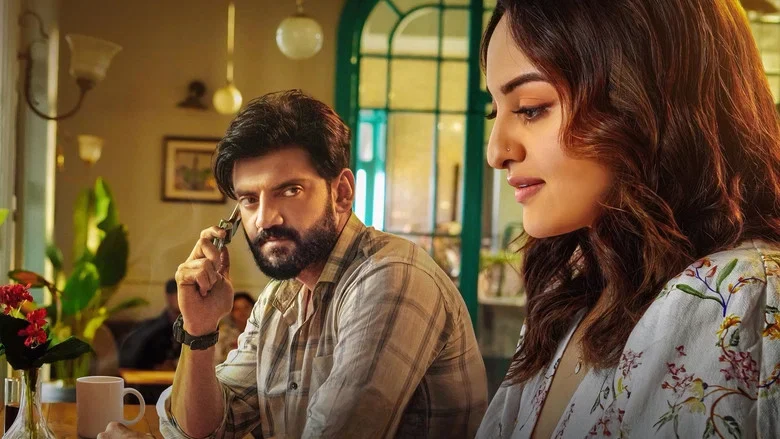
The premise is genuinely seductive: a bestselling author in 2026 discovers a battered flip phone that connects her to a socially ostracised man a decade in the past. What begins as an eerie, almost tender exchange curdles into something far more dangerous.
Samar, played by Zaheer Iqbal, refuses to treat Kiran’s rejection as final. The film’s smartest instinct is refusing to dress his fixation in the language of destiny; it lets the coercion show its teeth early.
Rawal builds his mystery around a concrete object rather than abstract dread, an approach that recalls the tighter spatial discipline he demonstrated in Udta Teer. Here, the phone becomes both lifeline and leash.
When Devotion Becomes Surveillance, Suspense Should Tighten, Not Slip
Act two escalates through stalking, threats, and deliberate interference with Kiran’s relationships. The problem is repetition: each new demand for information about her 2016 self lands with diminishing returns.
Samar’s demand that Kiran reveal details of her past self so he can reshape it is the film’s best-engineered sequence, a conversation that functions as a direct act of control. The screenplay, however, keeps returning to the same well.
Kiran’s central task, determining which parts of her identity have already been altered, should generate escalating dread. Instead, the film’s obsession with its own mechanics starts to mirror its antagonist’s fixation, and the tension slackens.
Sinha’s Stillness Against Iqbal’s Coiled Insistence
Sonakshi Sinha plays Kiran as a woman with authorship over her own life, not a victim waiting to be rescued. Watch her posture during the phone calls: shoulders squared, jaw set, voice dropping into a register that refuses to plead.
That controlled physicality carries the film further than its screenplay deserves, echoing the courtroom composure she brought to System. The difference is that here, her restraint has something genuinely threatening to push against.
Iqbal’s Samar is most unsettling in his stillness, a man who leans into the receiver rather than raising his voice, letting silence do the work of a threat. When he finally does raise his voice, the spell breaks; the character becomes ordinary.
The supporting ensemble, including Zarina Wahab in a brief maternal presence, registers mostly as texture. Their dramatic function remains thin, and the film rarely gives them room to complicate Kiran’s isolation.
Dual-Timeline Ambition Outpaces Its Own Rules
Cinematographer Utkarsh Marulkar is credited, though the film’s visual grammar for distinguishing 2016 from 2026 rarely rises above functional colour grading. The two eras blur together when they should feel like separate worlds pressing against each other.
Rawal’s direction is strongest in the intimate spaces, cramped rooms, close framing on hands gripping the phone, the low hum of a device that shouldn’t work. The sound design around each call does more suspense work than the dialogue.
What the film never quite clarifies is the causal logic of Samar’s interventions. How exactly does altering 2016 reshape 2026? The screenplay gestures at the rules without committing to them, and the ambiguity that should feel haunting starts to feel like evasion.
The tonal movement from romance to psychological threat is uneven, a problem the film shares with other recent entries in the genre, including the uneven procedural instincts of Reporting Live. Both films understand obsession intellectually without fully trusting it dramatically.
Echelon Productions Bets on a Star Vehicle in a Crowded Thriller Market
Echelon Productions, with PAM Studios and AND Productions attached as presenters, is wagering on Sinha’s name to carry a mid-budget thriller into a marketplace saturated with similar fare. The calculus is understandable; her presence guarantees a certain baseline of attention.
But the film’s commercial ceiling depends on whether audiences accept a romantic thriller where the romance is the threat. That’s a harder sell than the marketing suggests, and the theatrical window for this kind of dual-timeline mystery is narrowing.
Sinha’s box-office leverage remains real, particularly among viewers who have followed her from mass entertainers into more psychologically textured roles. Whether that goodwill translates into sustained footfalls across the opening week is the question Echelon’s balance sheet will answer.
The broader exhibition landscape for contemporary hindi thrillers rewards films that either commit fully to genre mechanics or transcend them entirely. This one sits uncomfortably in between.
The Uncomfortable Truth Buried in the Final Act
Kiran’s fight to reclaim her own history is the film’s moral centre, and it’s a genuinely potent one: the refusal to let someone else author your past is a form of self-defence. Rawal understands that the real horror isn’t the phone, it’s the presumption behind it.
What the climax leaves unresolved isn’t just the mechanics of time, but the question of whether obsession can ever be fully answered by anything other than its own exhaustion.
The film’s final images suggest a woman who has learned to guard her own story, even if the film itself never quite learns to guard its own focus.
Tu Hai Meri Kiran is a flawed, occasionally arresting experiment, a thriller that trusts its lead actress more than its own screenplay.
Sinha holds the centre with a quiet, unshowy resolve, and for stretches, that’s enough to make the static hum of an old phone feel genuinely menacing. It’s the rare film where the star outpaces the story, and the result lingers longer than the plot holes do.

Ankit Jaiswal is the Chief Author, covering Indian cinema and OTT releases with honest, no-filler criticism. An SEO strategist by background, he brings a research-driven approach to film writing, cutting through hype to tell you exactly what's worth your time.