Hanuman Ansh (2026): Shobhinaw Satyaa’s stillness anchors a sincere biopic that stumbles late
On a colonial-era platform, a barefoot sadhu produces a fistful of tickets and refuses to let British officials drag a fellow saint off the train. The apology he extracts is small, stubborn, and the most persuasive argument this uneven biopic ever makes.
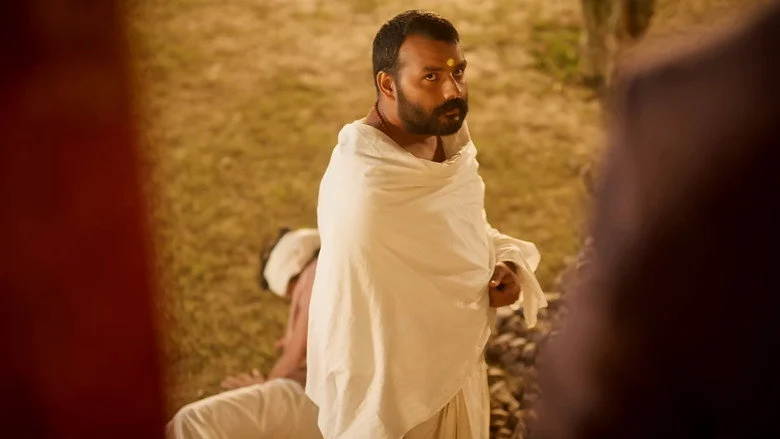
Shobhinaw Satyaa answers the temple test without a raised voice
In the Rajkot temple sequence, Shobhinaw Satyaa answers the Mahant’s probing with a stillness that reads as certainty, not shyness. He carries the same composure through the train confrontation and the Kainchi guidance, never pushing, rarely blinking. The calm smile audiences keep praising is not a tic; it is the performance.
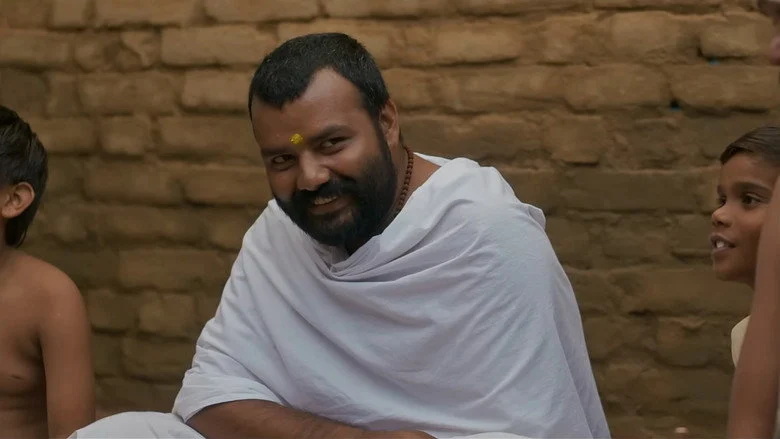
Give Vishal Chaturvedi the train sequence; the rest needed a rewrite
His strength is texture: Braj and Bundelkhand dialects, rural North India light, characters who never announce their own holiness. The screenplay’s weakness is structural. After the interval, miracle follows miracle without consequence, and the climax hands its biggest events to a sequel that has not been made.
A drowned boy surfaces, and the miracle machinery starts repeating
As biography, the film stays faithful to documented Neem Karoli Baba episodes, and the train sequence proves it. He produces tickets, insists a station be built, and extracts an official apology. Institutional arrogance meets quiet authority, staged without bombast.
The underwater meditation plays as devotional drama rather than spectacle; villagers grieve, then he resurfaces. Grounded shots of rivers and forests do work the visual effects cannot. Nature, the cinematography insists, is where his faith actually lives.
The Hanuman Chalisa forest rescue shows the genre at its best, devotion functioning as practical help. Yet these set pieces stop building toward anything in the second half. Repetition replaces progression, and the Kainchi climax arrives by chronology rather than drama.
Music carries more narrative weight than the script does. “Aavagaman”, “Saasa Haale”, “Jai Hanuman” and “Shri Ram Jai Ram” arrive as devotional punctuation, and the background score rarely overplays what it is asked to sell. Fewer miracles and more of this would have been a fair trade.
Chandan K Anand narrates the film into shape
Chandan K Anand’s Ram Nandan Bhosale gives the film its spine, ageing quietly through decades the screenplay skips entirely. He never begs for tears, which is why the framing device holds. Anil Rastogi’s Mahant Ji registers the boy’s depth in one appraising look, casting that signals a preference for gravitas over spectacle.
Films like this live or die on patience, and the Hindi Drama reviews collection rewards exactly that appetite.
Uttarakhand’s tax-free blessing beats any marketing campaign
Uttarakhand declared Hanuman Ansh tax-free after a screening for the Chief Minister, and the film wears that endorsement lightly. No censorship trouble, no casting noise, no manufactured outrage. A state government and a devotional audience reached the same verdict, and that accord is the film’s real engine.
Viewers were warmer than critics. IMDb sits at 8.9 from 8, 600 votes, with praise for cultural authenticity, the peaceful register, and Satyaa’s smile. The complaints repeat too: a repetitive second half, thin structure, threads left dangling.
In a packed hall, the chants do half the work the effects cannot, and that collective response explains the run better than any review.
What the film understands is that devotion here means service, not ecstasy. What he wants is practical: a station, respect for saints on trains. That refusal to separate the mystical from the mundane is the smartest thing in the script.
The final knock, followed by Baba’s voice promising to return, is a sequel hook dressed as benediction. It lands emotionally and cheapens the arc in the same breath. A biopic this patient should trust its own ending.
Against mainstream biopics, this one lacks polish and star power, and it knows it. What it buys instead is trust, earned through regional detail rather than scale. That trade is why the film outran its own budget.
DNA India’s Simran Singh rated it 3.5 out of 5, writing that it “does move you, leaves you impressed, not with the filmmaking, but with the journey of Baba.” I found the train sequence the only miracle that fully earns its staging.
The economics are stranger than the reviews. Against a Rs 2 crore budget, it returned Rs 1.08 crore India net in week one, per Mathrubhumi English, then kept running on word of mouth. Taran Adarsh called it the biggest success story of 2026.
See it in a regular theatre with a full house, where the chants and the silences land together; this is not a film built for a laptop. Go for Satyaa and the first half’s restraint. Skip it if repeated miracles and an unfinished ending will bother you more than they should.
Where this film builds atmosphere faster than momentum, Haiwaan review makes that imbalance its whole method.
Hanuman Ansh is worth one theatrical visit for Satyaa’s stillness and that railway platform, a solid 3 out of 5 that a sharper second half could have pushed higher.
Sincere belief undone by structural drift also shapes Maremma verdict.

Ankit Jaiswal is the Chief Author, covering Indian cinema and OTT releases with honest, no-filler criticism. An SEO strategist by background, he brings a research-driven approach to film writing, cutting through hype to tell you exactly what's worth your time.