Nayyi Navelli (2026): Yami Gautam Dhar’s Daayan Bride Comedy Dares You to Check Her Feet
Balaji Mohan plants a suspected daayan inside a Meerut joint family and lets the comedy curdle from there. The film’s wager is simple: domestic perfection as horror’s most efficient disguise.
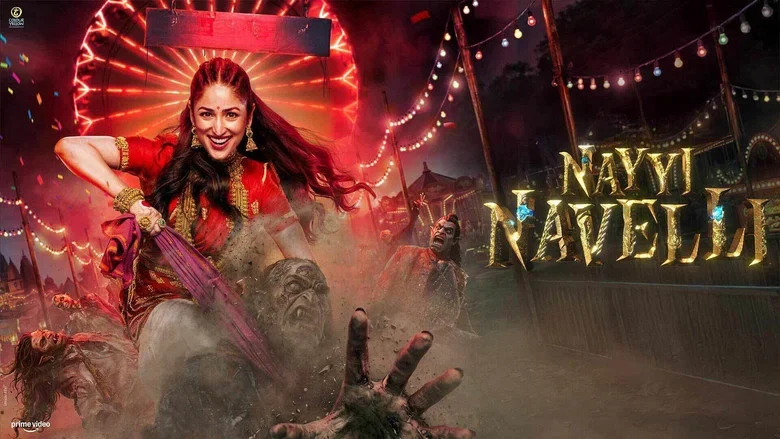
The Foot Inspection Is The Best Scene Bollywood Has Built All Year
A brother-in-law asking his new bhabhi to lift her feet so the family can examine her footprint shouldn’t be the most arresting image in a Hindi fantasy comedy. Yet that single folk ritual, the belief that a witch’s feet reverse direction, carries more narrative charge than most films manage across an entire third act.
Himanshu Sharma and Divy Nidhi Sharma’s screenplay understands that superstition, when staged inside a living room full of relatives pretending not to stare, becomes comedy and dread simultaneously. Mohini complies. The camera holds. Nobody breathes.
Yami Gautam Dhar Plays Competence As Menace
What Yami Gautam Dhar does across the film’s first hour is quietly extraordinary. Mohini reorganises a chaotic kitchen, soothes a fractious elder, and imposes order on a household that has apparently never known any, and every gesture lands like a threat because the screenplay refuses to let us decide whether warmth or calculation is driving it.
The performance operates on a knife’s edge between the ingratiating daughter-in-law and the predator waiting for the right moment. It recalls the contained, watchful authority she brought to System, where stillness did the work that dialogue should have. Here she adds a smile that never quite reaches the eyes.
Adinath M. Kothare’s Raja Awasthi is the film’s engine of doubt, a man who cannot accept good fortune without auditing it. His scenes opposite Gautam Dhar are staged with a formality that makes the growing suspicion feel almost indecent, like he’s interrogating a guest at his own table.
Balaji Mohan Builds Suspicion Out Of Crockery And Rotas
The director’s structural discipline is apparent in how he weaponises the mundane. Where a lesser filmmaker would reach for fog machines and creaking doors, Mohan stages his horror inside the rhythm of a functioning household, dishes cleaned too efficiently, a relative’s temper cured too completely.
The tonal architecture moves in three deliberate movements: harmony, then doubt, then public unmasking. It’s a structure that demands the ensemble hold the comedy while the lead carries the dread, and for long stretches, it works.
What the film shares with the regional-fantasy theatrics of Ranabaali is a willingness to let folk belief sit inside a commercial entertainer without apologising for it. Neither film treats its mythology as decoration.
The Supporting Ensemble Functions As A Greek Chorus Of Aunties
Mita Vashisht and Sunita Rajwar occupy the film’s edges with the specific, watchful energy of women who have survived decades of family politics and know when something is off. Neither is given a showcase confrontation, and that’s the screenplay’s loss, the aunties deserve their own third act.
The elder generation, including Sushmita Mukherjee’s Dadi, is largely consigned to reaction shots and mumbled invocations. The film treats them as atmospheric texture rather than dramatic participants, which flattens a household that should feel more dangerous.
The screenplay’s confidence in its central mystery means the ensemble rarely gets to generate its own comic friction. The relatives are mostly positioned around Mohini rather than in opposition to her.
A Runtime That Refuses To Commit To Itself
The film’s pacing wavers in its second half as the investigation mechanics begin to crowd out the domestic comedy that made the first hour so pleasurable. The foot-test sequence is a peak; the material surrounding it struggles to match that tension.
Songs like “Bhabhi Tabaahi” and “Phata Patakha” arrive with the requisite energy but interrupt the accumulating dread rather than deepening it. The background score, when it leans into folk instrumentation, is more effective than the needle drops.
The reveal structure, private suspicion escalating to family-wide confrontation, is the right shape. Whether the final twist earns the ninety minutes that precede it is where the film’s ambition and its execution begin to diverge.
Amazon MGM And Colour Yellow Are Betting On A Genre That Rarely Travels Well
For Amazon MGM Studios and Aanand L Rai’s Colour Yellow Productions, this is a calculated swing at the mid-budget Hindi fantasy-comedy space, a genre that has produced more misses than hits in the theatrical market over the past five years. The film’s commercial viability rests almost entirely on Gautam Dhar’s drawing power with family audiences.
The daayan premise is culturally legible across North India, but the tonal tightrope between comedy and horror is the hardest sell in mainstream Hindi cinema. The film’s theatrical window will reveal whether audiences want their superstition served with laughter or with dread, or whether they’ll wait for streaming.
This patient, character-first approach to supernatural storytelling signals a welcome tonal shift across contemporary Hindi fantasy, one that trusts domestic detail over jump-scare mechanics. Whether the market rewards that trust is the more interesting question.
What Nayyi Navelli Gets Right Is What It Refuses To Explain
The film’s smartest choice is leaving Mohini’s true nature ambiguous for as long as it does. The horror isn’t in what she is, it’s in the family’s inability to decide whether their good fortune is a blessing or a bill about to come due.
That ambiguity is the film’s real subject, and Gautam Dhar’s performance is calibrated to sustain it. She plays a woman who could be either thing, and the film is most alive when it refuses to tip its hand.
What remains after the credits is not the twist but the image of a family sitting in their suddenly immaculate living room, wondering what they’ve invited in. That discomfort is worth more than any reveal.

Ankit Jaiswal is the Chief Author, covering Indian cinema and OTT releases with honest, no-filler criticism. An SEO strategist by background, he brings a research-driven approach to film writing, cutting through hype to tell you exactly what's worth your time.