Reporting Live (2026): Parineeti Chopra Anchors a Sand-Mafia Procedural That Buries Its Own Threat
The sand arrives first. Before a single byline is argued over, Dhruv Tripathi’s camera settles on the quiet obscenity of it, trucks groaning out of a riverbed at an hour when only criminals and insomniacs are awake, headlights off, loads covered. It is the most honest image in Reporting Live, and the film knows it, returning to those riverbanks whenever the plotting starts to sag. What it never quite solves is how to make the people standing next to that sand feel as heavy as the sand itself.
Parineeti Chopra plays Sandhya, an ambitious young reporter who takes what looks like a manageable assignment and finds a syndicate underneath it. Deven Bhojani’s Vinod, her veteran cameraman, wants none of it. That friction, her appetite, his brake pedal, is the film’s real engine, and for a while it hums.
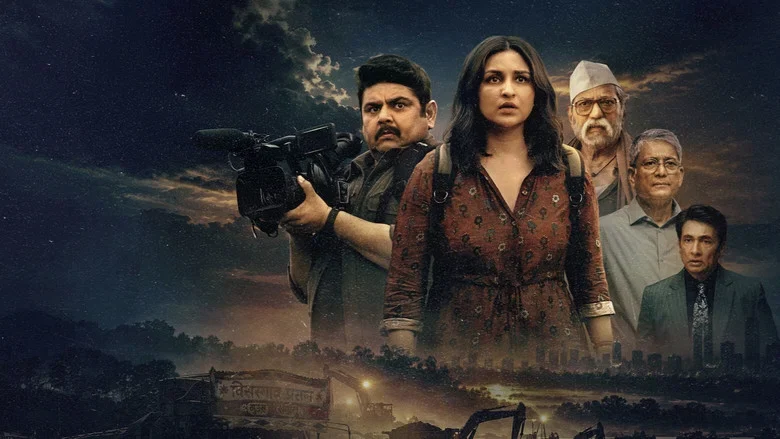
A Reporter’s Ambition Is a Weapon Until It Becomes a Liability
The screenplay, co-written by Tripathi with Mihir Jadhav, understands something most Hindi investigative thrillers forget: that a journalist’s danger isn’t the gun, it’s the notebook. Sandhya’s access is her vulnerability. Every source she cultivates, every road she drives down with Vinod, tightens the noose around a pair of people who have no institutional cavalry coming.
Where Tripathi’s staging stays disciplined is in the refusal to decorate. There are no drone sweeps of the mining belt, no slow-motion heroics. Just handheld proximity and the sound of an engine idling. It’s a leaner instinct than the one that sank the self-serious sprawl of Toxic, which mistook volume for dread. Here, the dread is quieter and, in the first hour, more effective.
Then the second hour arrives, and the film begins to mistake movement for escalation. Sandhya and Vinod go from gathering evidence to being hunted, and the screenplay responds by simply making them run more. The sand mafia, never a named face, always a network, loses its specificity the moment it becomes a generic pursuer.
Parineeti Chopra Finds the Reporter, Not the Heroine
Chopra’s best work here is in the small physical tells of a woman who has decided to be brave before she has decided to be smart. Watch her in the early reporting scenes: she leans into a source’s space a half-step too eagerly, pen already out, and you can see the calculation lagging behind the hunger. It’s a genuinely unflattering performance choice, and it’s the right one.
What she doesn’t get is a scene that lets her break. The screenplay keeps Sandhya professional through every crisis, which is admirable in theory and airless in practice. The restrained, bone-tired register that anchors Chevittorma, a performance built on what a body does when it has stopped performing, is exactly the note missing from Reporting Live‘s third act. Chopra has the range. The script never asks.
Bhojani is the film’s quiet win. Vinod’s caution is played not as cowardice but as a man who has seen what happens to reporters who get too close, and Bhojani communicates that history in the way he handles his camera, protective, almost paternal, as if the equipment is the only thing he can still control. The two of them share a wordless beat in a car after a near-miss that is better than any line of dialogue in the film.
The Ensemble Is a Casting Flex, Not a Dramatic Resource
Adil Hussain, Amol Palekar, Shekhar Suman, Saswata Chatterjee, Nassar, Pitobash, the credits read like a wish list, and the film uses them like one. Hussain gets maybe four scenes and no arc. Palekar appears, registers, vanishes. These are actors hired for the gravity their faces carry, not for anything the screenplay asks them to do. It’s the cinematic equivalent of putting a famous painting in a hallway.
The sand mafia itself is the film’s biggest structural gamble and its clearest failure. By refusing to personify the antagonist, Tripathi aims for systemic menace, the idea that the rot is everywhere and nowhere. But menace needs a face to focus on, or at least a name to fear. What we get instead is an abstraction that threatens, pursues, and never quite lands.
The tonal tightrope that a film like Vibe fell off, mistaking genre energy for stakes, is one Reporting Live mostly avoids, but only because it has almost no energy to spare. It plays everything at the same muted frequency.
When the Camera Stops Reporting and Starts Just Watching
Tripathi’s visual grammar is documentary-adjacent: natural light, real locations, a preference for medium shots that keep Sandhya and Vinod in the same frame even when they’re arguing. That last choice is smart, it visualizes the partnership as a single unit under pressure. But the film never varies its rhythm. Every scene is shot and cut at the same tempo, whether it’s a tense source meeting or a chase through a mining yard.
The score is worse than invisible; it’s instructive. Strings swell to tell us when to be afraid, then vanish when the film forgets to be. Silence would have served better. The riverbank sequences, which should be the film’s sonic signature, water, engines, the crunch of tires on gravel, get buried under music that doesn’t trust them.
And that’s the deeper problem. Reporting Live is a film about the cost of bearing witness, made by people who seem nervous about letting the audience do the same. It keeps explaining its own stakes instead of letting the sand, the trucks, and the exhausted faces of its reporters carry the weight.
What the Ending Refuses to Say, and Why That’s Not Enough
The final act pivots on the reporters becoming targets, and the film’s resolution, such as it is, refuses the clean catharsis of a published exposé. No triumphant byline. No syndicate dismantled. Just survival, and the implication that the story will continue without them. It’s a defensible choice, and a bleak one.
But bleakness isn’t automatically depth. The film ends without answering the question it spent two hours asking: what was it for? Sandhya risks everything, loses nothing she can’t recover, and the system that threatened her simply recedes back into the riverbed. That’s not ambiguity. That’s evasion dressed as ambiguity.
What Reporting Live ultimately signals is a growing appetite in contemporary Hindi thrillers for stories about ordinary professionals in over their heads, reporters, photographers, small-town investigators, rather than larger-than-life heroes. That’s a healthy instinct. But instinct isn’t execution, and this film has the bones of something sharper than what it delivers.
It is a well-intentioned, underpowered procedural that trusts its premise more than its people. Chopra and Bhojani deserve a better vehicle. The sand mafia deserves a face.
Rating: 2.5 / 5
Somewhere in those riverbed sequences is the film Reporting Live wanted to be, patient, specific, and genuinely angry. What we got instead is a movie that watched its own best footage and then looked away.

Ankit Jaiswal is the Chief Author, covering Indian cinema and OTT releases with honest, no-filler criticism. An SEO strategist by background, he brings a research-driven approach to film writing, cutting through hype to tell you exactly what's worth your time.