Magudam (2026): Vishal’s Ambitious Action Drama Sinks Under Its Own Weight
The 1965 opening sequence lands with brutal force, a young boy named Linga clawing his way out of a child-trafficking racket in Visakhapatnam, his escape setting off a chain of violence that will echo across decades. It’s a genuinely arresting start that promises a muscular, mythic revenge saga. But Magudam, Vishal’s 185-minute action-drama, spends the rest of its runtime struggling to live up to that opening punch.
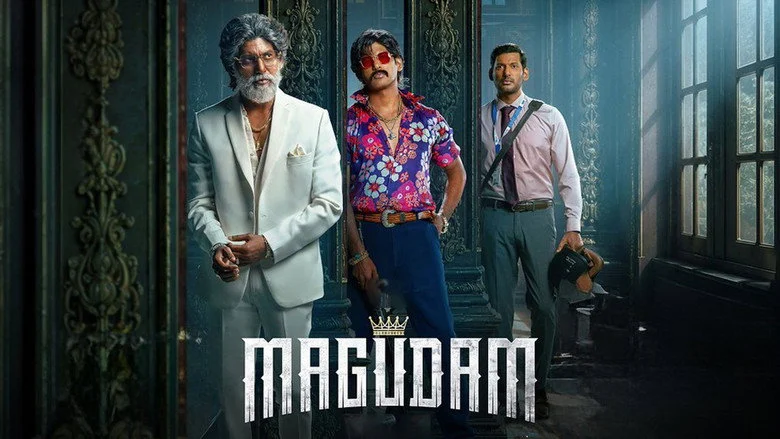
Vishal commits fully to the dual role of Krupakaran and his father Linga, and his performance is the film’s single most valuable asset. He shifts between the hardened, older Linga and the present-day Krupakaran with visible conviction, carrying the emotional weight even when the screenplay around him falters. The action climax, repeatedly mentioned as one of the film’s more effective stretches, finally gives him the kind of large-scale sequence his efforts deserve.
A Multi-Timeline Structure That Collapses Under Scrutiny
Director Vishal clearly aimed for something bigger than a standard revenge drama, weaving together period and present-day threads around the coastal shipping business. The ambition is visible in every frame, from the period detail to the broad power struggles that define the world.
But ambition without discipline produces chaos. The screenplay, co-written by Vishal with Ravi Arasu’s story and dialogues from Pon Parthiban and Anandh Kumaresan, cannot sustain its non-linear design. Plot threads get tangled, motivations blur, and the middle section becomes an unwieldy slog that tests patience long before the climax arrives.
Indian Express gave it a 2/5, calling it “an ambitious, action-heavy revenge saga that boasts committed performances across three timelines, but struggles with a screenplay that cannot always hold its multi-layered structure together.” That assessment captures the film’s central paradox, so much effort, so little cohesion.
Action Craft: Big Setpieces, Uneven Rhythm
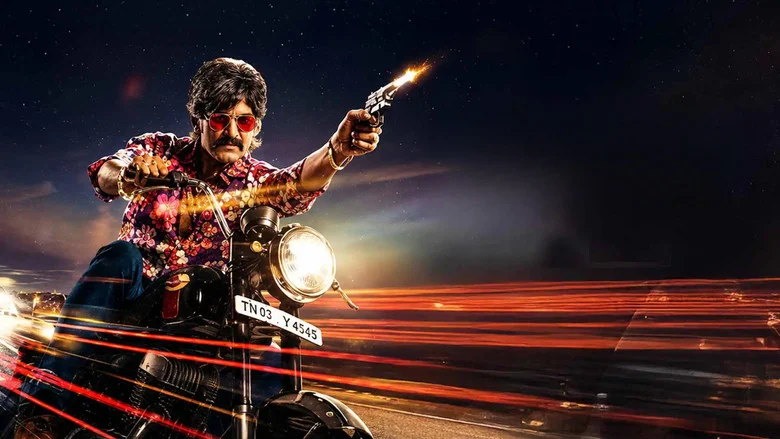
The action sequences themselves show genuine craft. The opening escape sequence functions as the key origin scene, establishing Linga’s violent world with raw efficiency. It’s the kind of setpiece that makes you lean forward, hoping the rest of the film will match its intensity.
The climax action stretch, widely singled out as the film’s most effective genre moment, delivers the mass-commercial staging that Vishal fans came for. The geography of the fight is clear, the stakes feel real, and for those twenty minutes, the film’s problems fade into the background.
Between those bookends, however, the pacing collapses. The film leans on formulaic plotting and mass-commercial staging over sustained emotional development, and the long runtime exposes every structural weakness. What should feel like momentum instead feels like repetition, with the coastal-business backdrop never quite becoming the textured world it promises.
Supporting Cast: Present but Underserved
Anjali and Dushara Vijayan are both listed as principal cast members, but neither receives material worthy of their presence. Their roles lack the sharp definition that would give Krupakaran’s journey emotional stakes beyond the father-son revenge thread.
The antagonist situation is equally vague, no clearly identified villain emerges, with opposition forces described more as part of a larger power structure than as a sharply written individual threat. This diffuses the conflict and makes the revenge arc feel generic rather than personal.
What the casting does signal is an intent to build a broad, ensemble-driven world. The problem is that the screenplay never gives these actors enough to work with, leaving the film feeling populated rather than inhabited.
The film’s ambition extends to its production scale, which trade sources acknowledge as substantial. But that scale couldn’t save it commercially, TrackTollywood reported Day 1 India net at just ₹0.82 crore, with Sacnilk’s cumulative first-week figure of ₹2.38 crore confirming a weak theatrical run. BoxOfficeWala’s worldwide estimate of ₹2.80 crore tells the same story: a high-profile release that audiences simply didn’t show up for in numbers.
Critics have been blunt about the film’s failures. One review called it “a crown too heavy for weak storytelling, ” while another dismissed it as “an overstuffed formula film.” The harshest assessment labeled it a “muddled father-son drama disappoints, ” and it’s hard to argue with the core of that criticism. The film tries to be a generational saga, a business thriller, and a mass actioner simultaneously, and it fails to fully succeed at any of them.
For more analysis of Tamil action dramas and their execution, browse our Tamil Action reviews.
What Magudam Gets Right and Where It Falters
The film’s strengths are real but scattered. Vishal’s committed performance anchors the enterprise, and the action sequences show visible ambition in their staging. The period-and-present timeline design is structurally adventurous, even if the execution never quite matches the concept.
The weaknesses are harder to ignore. The screenplay’s inability to hold its multi-layered structure together creates confusion where there should be tension. The excessive runtime, 185 minutes for a story that feels half that length, turns what could have been a tight revenge drama into an endurance test. The emotional payoff, when it finally arrives, feels earned more by Vishal’s performance than by the writing.
Audience complaints mirror the critical consensus: excessive runtime, confusing narrative choices, and weak emotional payoff. The praise centers on Vishal’s dual-role work and the action setpieces, but those positives aren’t enough to overcome the film’s fundamental pacing problems. The first half carries setup value but still feels burdened; the second half stretches material beyond its effective length entirely.
This is a film that needed a firmer editorial hand and a script that trusted its audience to follow a cleaner narrative line. The raw materials for a solid action drama exist here, the performances, the scale, the ambition, but they’re buried under a narrative load that the screenplay simply cannot carry.
For a similar case of a lead actor holding together a flawed script, see how Nayanthara’s presence gives energy to Hi review despite its weak payoffs.
If you’re a Vishal fan who can tolerate long commercial revenge dramas, Magudam offers moments of genuine entertainment, particularly in its action stretches. The regular theatrical or OTT format serves it fine, there’s no visual spectacle here demanding IMAX. But if you value tight writing and disciplined pacing, this 185-minute exercise in overreach will test your patience. I found myself checking the runtime more than once during the middle sections, and that’s never a good sign.
Magudam is a film that mistakes length for depth and complexity for sophistication, earning a modest 2/5 for its committed performances and ambitious action staging, but ultimately failing as a coherent dramatic experience.
For another look at a star carrying an uneven film, check how Awarapan 2 verdict handles similar structural challenges.

Ankit Jaiswal is the Chief Author, covering Indian cinema and OTT releases with honest, no-filler criticism. An SEO strategist by background, he brings a research-driven approach to film writing, cutting through hype to tell you exactly what's worth your time.