Comrade Kalyan (2026): Sree Vishnu’s Comic Timing Can’t Save a Tonally Confused Naxal Drama
The Alankar touring talkies has seen better days. Its screen is patched, its seats are torn, and its projector sputters like a dying lung. But for Kalyan, a small-time operator in the early-1990s Andhra-Odisha borderlands, it is everything. He screens R. Narayana Murthy films not out of ideological conviction but because the village is red, and red sells tickets. It is a wonderfully cynical premise for a comedy, a man who weaponises communism for profit. For roughly forty minutes, Comrade Kalyan hums with the scrappy, lived-in energy of a story that knows exactly what it is. Then the Naxals arrive, the kidnappings begin, and the film loses its nerve entirely.
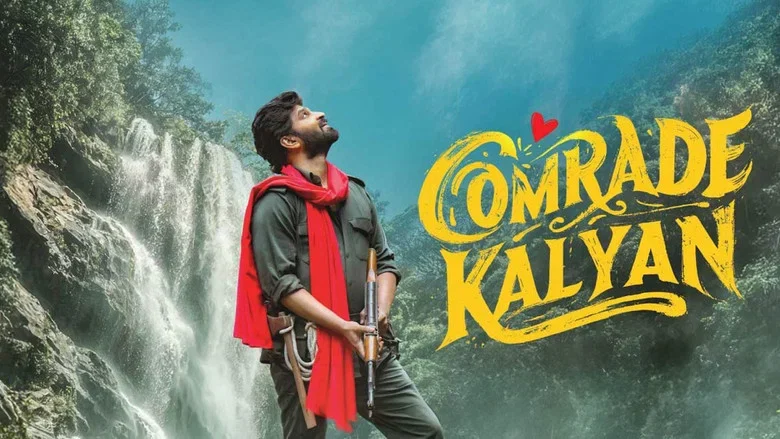
When A Conman’s Scheme Collides With A Revolution He Never Believed In
Director Janakiram Marella establishes his world with affectionate specificity. The Alankar is not just a setting; it is a social ecosystem where film reels, political slogans, and petty commerce bleed into one another. Kalyan’s scheme is simple: lease the theatre, exploit the village’s Maoist sympathies, and pocket the difference. His pursuit of Sitara, a young Odia woman drowning in her brother’s debts, is equally transactional at first, he offers to clear what she owes, not out of romance but because he sees an opening. The film’s smartest early passages understand that self-interest, not ideology, drives ordinary people into extraordinary circumstances.
Then the screenplay makes a fatal miscalculation. Kalyan’s debt intervention accidentally brands him a Naxal sympathiser, and suddenly the film wants us to believe he is caught between revolutionary violence and state repression. The transition is jarring not because genre shifts are inherently bad, but because Marella never earns the tonal leap. One moment we are laughing at Dubai Babu’s schemes; the next, a politician is kidnapped and IPS officer Jart Kuti is cracking skulls. The film treats this escalation as inevitable when it is merely convenient.
Sree Vishnu’s Comic Instincts Deserve A Better Film Than This
Sree Vishnu has spent his career perfecting a very specific screen presence: the affable schemer who is never quite as clever as he thinks. He brings that same energy to Kalyan, and for the first act, it works beautifully. Watch him negotiate with a local lender, his eyes dart, his shoulders hunch, his voice drops to a conspiratorial whisper. He is not a hero; he is a man trying to survive a bad situation with his dignity and his theatre intact. It is a performance built on small physical tells rather than grand gestures, and it keeps the film grounded even as the plot spirals.
His chemistry with Sudharshan and Satya generates the film’s only consistently reliable pleasure. The three of them bicker, scheme, and improvise with the easy rhythm of performers who understand comic timing is about listening, not just delivering lines. There is a sequence where they attempt to stage a fake political rally to drum up ticket sales, the choreography of their incompetence is genuinely funny. But the film keeps interrupting them. Every time the comedy finds its groove, Marella cuts to Shine Tom Chacko’s Jart Kuti scowling in a police jeep, and the air goes out of the room.
A Villain Who Is All Threat And No Texture
Shine Tom Chacko is a formidable actor, but Jart Kuti is written as a function, not a character. He exists to apply pressure, to show up whenever the plot needs a complication, and to deliver dialogue about eliminating Naxal activity with the grim determination of a man who has never questioned his orders. There is no scene where we understand what drives him, no moment of doubt, no glimpse of the ideology he is defending. He is a uniform with a scowl, and the film mistakes relentless enforcement for dramatic depth.
Mahima Nambiar fares slightly better as Sitara, though she is given little to do beyond suffer nobly. Her character’s predicament, family debt, an absent brother, a lender demanding marriage, is the film’s emotional engine, but once Kalyan pays her debt, she recedes into the background. The romance that supposedly drives the plot becomes an afterthought, and Nambiar’s performance, which carries real vulnerability in early scenes, is left stranded. The comparison to her work in Your's Sincerely RAAM is instructive: there, she had a character with agency; here, she has a plot device.
When Comic Improvisation Becomes Political Violence, The Film Forgets To Connect The Dots
The central problem is causal. Kalyan becomes “Comrade Kalyan” not through any conscious choice but through a series of misunderstandings so contrived they beggar belief. He pays a debt, and suddenly he is a revolutionary. He attends a meeting, and suddenly he is complicit in a kidnapping. The screenplay treats these escalations as inevitable, but they are merely convenient. There is no moment where Kalyan weighs the cost of his actions, no scene where he understands that his petty schemes have real consequences. The film wants credit for political complexity without doing the work of dramatising it.
This is where the comparison to Toxic becomes instructive. Both films attempt to blend commercial entertainment with darker political undercurrents, and both collapse under the weight of their own ambition. But where Toxic at least committed to its grim tone, Comrade Kalyan keeps retreating into comedy whenever the drama becomes too heavy. The result is a film that never commits to anything, not the romance, not the politics, not the comedy. It is a series of tones in search of a movie.
The Craft Is Competent, But Competence Is Not Enough
Vijay Bulganin’s background score is the film’s most reliable asset. He understands when to underline a joke and when to let silence do the work, and his themes for the Naxal sequences carry a genuine sense of dread. The cinematography, unfortunately, does not match his ambition. The film alternates between warm, textured lighting for the theatre sequences and flat, overexposed compositions for the political material. It is as if the visual language cannot decide whether this is a nostalgic period piece or a gritty thriller.
The editing betrays the screenplay’s structural problems most clearly. The first half moves with a leisurely, character-driven rhythm, allowing the comedy to breathe. The second half accelerates into a blur of chases, confrontations, and exposition dumps. Characters appear and disappear without introduction; subplots are raised and abandoned. Radhika Sarathkumar’s mother character, for instance, generates some early comic friction with her petty legal troubles, but she vanishes entirely once the kidnapping plot takes over. The film forgets its own supporting players.
What The Film Could Have Learned From Its Own Setting
The early-1990s Andhra-Odisha borderlands were a genuinely fascinating moment in Indian history, a time when cinema, commerce, and political violence existed in uneasy proximity. A film that truly engaged with that complexity could have been something remarkable. The touring talkies, in particular, were a unique cultural institution: travelling cinemas that brought entertainment to remote villages, often serving as the only connection to the outside world. The film gestures at this richness but never fully explores it.
Instead, it settles for a familiar template: the lovable rogue who gets in over his head, the beautiful woman who needs saving, the ruthless officer who represents the state, and the political backdrop that provides stakes without requiring genuine engagement. It is a formula that has worked before, but it requires a coherence that this screenplay never achieves. The film’s ambitions are admirable; its execution is not.
Contemporary Telugu cinema has demonstrated that commercial entertainment and political complexity can coexist, that a film can be funny and thoughtful, entertaining and challenging. The best examples of contemporary Telugu dramas understand that tonal shifts require careful calibration, that comedy and tragedy can coexist if the transitions are earned. Comrade Kalyan understands this in theory but not in practice.
The Ending Resolves Nothing Because Nothing Was Properly Established
Without revealing specifics, the final act attempts to tie together the romantic, comic, and political threads in a climax that feels both overstuffed and underwhelming. Characters make choices that contradict their earlier behaviour; plot points are resolved through coincidence rather than causality; and the film ends on a note that is neither triumphant nor tragic, merely exhausted. It is the ending of a film that ran out of ideas rather than one that reached a conclusion.
The comparison to Epic – First Semester is unavoidable. Both films attempt to blend romance, comedy, and social commentary, and both struggle with the same fundamental problem: they do not trust their own stories enough to commit to a single tone. They hedge, they retreat, they try to be everything to everyone. The result is a film that satisfies no one.
Sree Vishnu deserves better. He is a genuinely gifted comic performer, and his work here suggests he could carry a more focused film with ease. But he cannot save a screenplay that does not know what it wants to be. The Alankar touring talkies may have seen better days, but so has this film.
Rating: 2.5 / 5
The final image, Kalyan standing alone in the ruined theatre, the projector finally dead, is meant to be elegiac. Instead, it plays as accidental autobiography: a film that burned through all its creative capital and had nothing left to project.

Ankit Jaiswal is the Chief Author, covering Indian cinema and OTT releases with honest, no-filler criticism. An SEO strategist by background, he brings a research-driven approach to film writing, cutting through hype to tell you exactly what's worth your time.