Chevittorma (2026): Dileesh Pothan Anchors a Deathbed Drama That Refuses Easy Absolution
Leo Thaddeus opens his camera on hands, not faces. A caregiver’s hands, folding a cloth, adjusting a pillow, moving through the small rituals that precede a death. The film’s first minutes belong to Theresia (Pauly Valsan), and Thaddeus shoots her work with a documentary plainness that will pay off later, once the room fills with people who have stopped being useful to each other.
Payyammal Varkichan (Dileesh Pothan) is a wealthy farmer whose body has begun its final betrayal. His response is not fear. It is administration, of his dignity, his silence, and the terms on which anyone is permitted near him. Into this sealed chamber walk George (George Kora) and his wife, returned after a decade of estrangement, and the film settles into its real subject: the arithmetic of who owes whom an apology before the clock runs out.
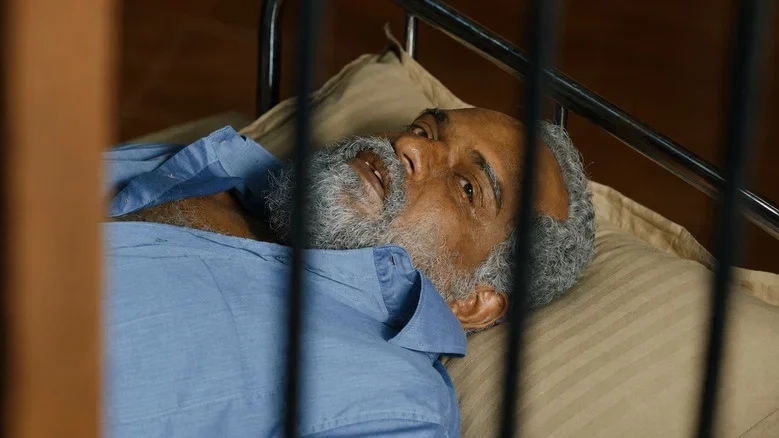
Theresia Prays. Varkichan Counts What Prayer Costs Him
Valsan plays Theresia as a woman without performance. She has sat at so many bedsides that death has lost its theatrical gravity for her; she urges repentance the way a nurse checks a pulse, matter-of-factly, without pleading. This is the film’s wisest casting decision. A more self-consciously saintly actor would have turned Theresia into a moral referee. Valsan instead makes her a witness, someone who has learned that the dying rarely say what the living need to hear.
Against her, Pothan builds a performance out of refusal. Varkichan will not repent, will not soften, will not grant George the satisfaction of a father who breaks first. The character’s authority lives in his upper body: he keeps his spine straight even when propped against pillows, and Pothan delivers his lines with the flat economy of a man who has decided that every word is a concession. The tension is not whether he will die. It is whether he will blink.
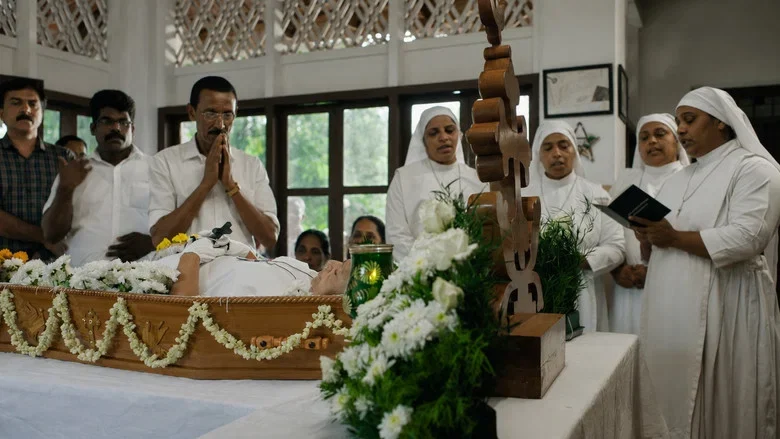
A Son Who Returns To Watch, Not To Reconcile
George Kora’s George is the film’s most difficult assignment, because passivity is nearly impossible to play without disappearing. He and his wife occupy the house like tenants waiting out a lease, and Kora’s stillness in the doorway scenes, hands at his sides, weight balanced evenly, eyes fixed on his father’s face, communicates ten years of rehearsed indifference better than any monologue could.
The screenplay, also Thaddeus’s, never supplies the specific origin of the family rupture, and this is a deliberate withholding rather than a gap. We get fragments: the farm, the money, something George needed that Varkichan refused. The vagueness forces the audience into the same position as Theresia, watching two men who know the full story refuse to tell it. It is an elegant structural gamble, though it costs the film a measure of narrative traction in its middle stretch.
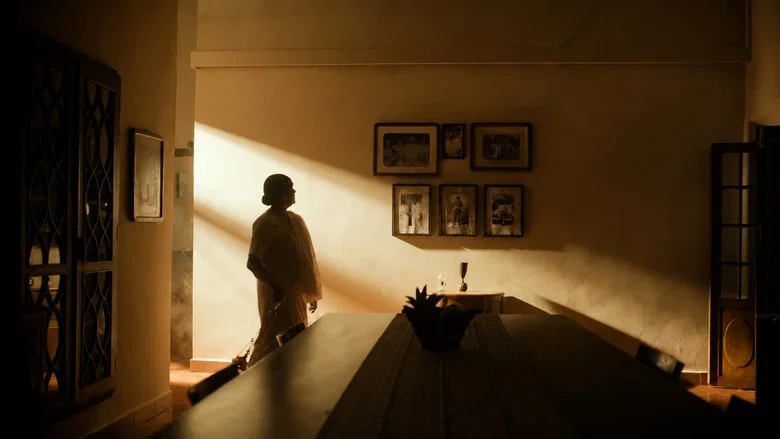
Where The Confined Frame Starts To Strain
Thaddeus’s instincts as a director are architectural rather than kinetic. He blocks scenes so that Varkichan and George are almost never in the same shot cleanly; someone’s shoulder, a doorframe, or Theresia’s back intrudes between them. The strategy is legible, inherited anger as physical obstruction, but it becomes repetitive. By the film’s second half, the visual grammar has said what it has to say, and the camera has nowhere new to go.
The 95-minute runtime is both mercy and limitation. The compression keeps the film from wallowing, but it also means the reconciliation mechanics, when they arrive, feel earned by duration rather than by dramatic development. Thaddeus’s earlier work shares this tendency toward stripped-down psychological friction, and the comparison is instructive: the ambition is consistent, but the execution here relies more on the premise’s inherent gravity than on any new formal invention.
What Pothan Does With A Man Who Won’t Kneel
The performance is the film’s load-bearing wall. Pothan has spent his career playing men whose authority is administrative, bureaucrats, fathers, functionaries, and the register he finds here is a refinement of that type into something colder. His best scene arrives late, in near-total silence: Varkichan alone, breathing carefully, listening to the house around him. No dialogue, no music cue, no camera movement. Just an old man measuring the cost of everything he has refused to say.
It recalls the psychological weight Pothan carried in Oru Durooha Saahacharyathil, where an uneven script still couldn’t blunt his instinct for playing men in quiet crisis. Here the material is sturdier, and he returns the favor by giving Varkichan a dignity that never curdles into nobility. He is not a misunderstood patriarch. He is a stubborn man who has chosen his pride over his son, and Pothan never lets us forget that choice.
The Problem With A Genre That Rewards Crying
Malayalam cinema has been unusually productive lately in its willingness to sit with unglamorous emotional states, and the film’s refusal to stage a cathartic deathbed confession places it firmly in that lineage. The closest thematic sibling is Aali, which similarly builds tension from what characters won’t admit to each other, though that film’s romantic framework gives its silences a warmer texture than Thaddeus allows himself here.
Where the screenplay genuinely distinguishes itself is in its refusal to let Theresia’s faith function as a solution. She prays with the dying, but the film treats her prayers as labor rather than magic. Nobody is saved by a well-timed confession. The inherited anger is named, examined, and then, crucially, left partially unresolved, which is the most honest choice the film makes.
The Ending Doesn’t Flinch, And That’s The Point
Thaddeus resolves the film not with reconciliation but with continuation. The anger doesn’t end; it changes hands. What the final scenes argue, quietly, without sermonizing, is that forgiveness is not a deathbed transaction but a decision that has to be made by the living, repeatedly, long after the person who wronged them is gone. That is a harder thesis than the genre usually permits, and it earns the film its modest but real distinction.
What holds it back from something greater is the thinness of its middle act and the sense that Thaddeus trusts his premise more than his scenes. The film knows exactly what it wants to say about pride and mortality. It is less certain how to fill the space between saying it and showing it. Still, in a landscape where Toxic demonstrated how quickly a heavy premise can collapse under its own self-seriousness, Chevittorma’s restraint reads as discipline rather than timidity.
This is the kind of small, patient character work that suggests a maturing appetite across contemporary Malayalam dramas for stories that trust their actors over their plot mechanics. It doesn’t always succeed, but it never insults the audience by pretending death resolves anything.
Rating: 3 / 5
Chevittorma ends the way most real deathbeds do, with the living still arguing, the dead already past caring, and a house full of people who will spend the rest of their lives deciding what they should have said. Thaddeus doesn’t tell us whether they ever figure it out. That refusal to console is the film’s only true act of mercy.

Ankit Jaiswal is the Chief Author, covering Indian cinema and OTT releases with honest, no-filler criticism. An SEO strategist by background, he brings a research-driven approach to film writing, cutting through hype to tell you exactly what's worth your time.