Enna Vilai (2026): A National Award Winner’s Directorial Debut Dips Its Toes in the Water, But Never Dives In
There is a moment early in Enna Vilai where the camera simply watches the tide retreat, leaving behind a scatter of copper coins pressed into wet sand. It’s a gorgeous, unforced image, the kind that suggests a filmmaker who trusts silence over exposition. That the man behind it, Sajeev Pazhoor, wrote Thondimuthalum Driksakshiyum should come as no surprise. What does surprise is how quickly the film abandons that patience for something closer to a courtroom procedural, trading salt-air texture for gavel-heavy rhetoric.
Make no mistake: this is a sincere film, and sincerity counts for something. But sincerity, as any festival juror will tell you, is not the same as dramatic rigor.
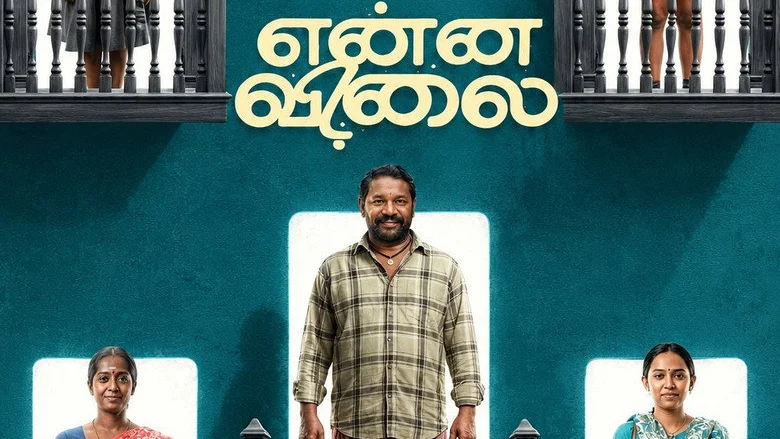
From Shoreline to Witness Box: A Premise Worth Protecting
The setup is genuinely novel, and credit where it’s due, Pazhoor has built his story around a livelihood most Tamil cinema ignores entirely. Karunaas plays Thavasi Muthu, a Rameswaram fisherman who makes his living collecting coins that devotees toss into the sea. When a gold pendant washes ashore in his net, his quiet subsistence becomes evidence, then accusation, then indictment. The escalation is clean, almost fable-like in its economy.
Karunaas, marking 25 years in the industry, brings an unhurried physicality to the role. Watch his hands in the early stretches, the way he sifts wet sand without urgency, as though the sea owes him nothing and he expects nothing in return. It’s a performance built on restraint, and it’s the film’s sturdiest asset. When the accusations arrive, his stillness reads less as passivity than as a man recalibrating what he’s willing to lose.
Nimisha Sajayan, as Advocate Kanchana, is handed the film’s structural burden, she’s the bridge between Thavasi’s world and the legal machinery that will grind against it. Pazhoor reportedly kept her role ambiguous during narration, a choice that pays off in her early scenes; she moves through the community with an observer’s neutrality before revealing her professional allegiance. The reveal lands, though the film never quite decides whether she’s a character or a function.
The Second Act Problem: When a Thriller Forgets to Thrill
Here is where Enna Vilai stumbles, and it stumbles in a way that’s instructive rather than embarrassing. The film’s middle hour, which should tighten the screws, instead loosens them. Courtroom sequences unfold with a procedural flatness, shot-reverse-shot exchanges, dutiful close-ups on documents, the rhythmic thud of a gavel that announces consequence without generating it. For a film whose entire dramatic engine is the question of whether a poor man can survive a system designed to consume him, there’s remarkably little friction.
Compare this to the way Haiwaan verdict also struggled to convert a strong atmospheric premise into sustained third-act momentum, both films share a tendency to mistake the accumulation of incident for escalation of stakes. The difference is that Enna Vilai has the better screenplay underneath it, which makes the sag more frustrating, not less.
Cinematographer Alby Antony shot across 56 locations, Rameswaram, Chennai, Puducherry, Kochi, and the coastal sequences carry a documentary immediacy that the interiors never match. There’s a visual argument buried in the film: the sea is indifferent and honest, the land is bureaucratic and cruel. But Pazhoor never quite makes that argument explicit, and the film’s visual grammar drifts as a result.
Festival Laurels and the Gap Between Acclaim and Execution
The film arrives trailing real credentials: Best Feature Film at the Mannheim Arts and Film Festival, Best Screenplay at the Dadasaheb Phalke International Film Festival, screenings at over a dozen international events. These aren’t negligible honors. But festival recognition for a socially rooted drama often rewards intention as much as execution, and Enna Vilai is a case study in that gap.
Sam C.S.’s score is tasteful to a fault, the single “Kadaladum, ” with Antony Daasan’s vocals, is the film’s most emotionally direct passage, and it arrives in a sequence that earns its melancholy. Elsewhere, the music works so hard to signal gravity that it occasionally smothers scenes that could breathe on their own. Sreejith Sarang’s editing is competent but never finds a rhythm for the legal sequences; they proceed at a uniform tempo, neither accelerating toward verdict nor lingering on the human cost.
The supporting ensemble, Y Gee Mahendran, Poornima Bhagyaraj, Nizhalgal Ravi, Deepa Shankar, populate the margins with professional ease, but the film gives them little to do beyond embody institutional resistance. Shashaa Shivakumar’s Manimegalai, her first rural role, has a lived-in quality that the screenplay doesn’t fully exploit. One wishes Pazhoor had trusted his performers to carry more of the argument than his dialogue does.
A Clean Entertainer, a Certificate, and a Question of Intent
Pazhoor has publicly expressed surprise that the film received a U/A certificate rather than a U, describing it as a clean entertainer. It’s a curious remark for a film that wants to indict systemic injustice, the very subject matter implies a certain hardness, a willingness to look at ugliness without flinching. Enna Vilai flinches. Its villains are abstract, its cruelties procedural, its resolution conciliatory. The film wants to be about the price of dignity, but it never quite names the currency.
For audiences who value social drama with a gentle touch, the kind of film that plays on a Sunday afternoon and leaves you thoughtful rather than shaken, this will land. As we frequently examine across Tamil Thriller reviews, there’s a real audience for cinema that treats rural lives with dignity rather than exoticism. Enna Vilai does that. It just doesn’t do much else.
Those seeking the knife-edge moral inquiry of Pazhoor’s writing on Thondimuthalum Driksakshiyum, a film that understood how a single object could detonate an entire social order, should temper expectations. That film’s genius was in its refusal to resolve; this one resolves too easily, and in doing so, lets its protagonist, and its audience, off the hook. For another perspective on recent South Indian releases balancing festival ambition with theatrical demands, see our take on Hanuman Ansh review.
Verdict: A Respectable Debut That Mistakes Gentleness for Depth
Enna Vilai is a film made with care by people who believe in cinema’s capacity to illuminate ordinary lives. That belief is visible in every frame of Karunaas’s performance and in the salt-stained textures of Alby Antony’s coastal photography. But belief alone doesn’t make a thriller thrilling, and a social drama that pulls its punches is ultimately a social drama that has chosen comfort over confrontation.
Watch it if you’re drawn to rooted Tamil storytelling, appreciate Karunaas’s understated craft, or want to support festival cinema making the leap to mainstream release. Skip it if you’re expecting the moral complexity of Pazhoor’s screenwriting pedigree or a legal drama with genuine teeth.
Rating: ★★½ / 5, A sincere, well-performed film that never quite becomes the film it wants to be.

Ankit Jaiswal is the Chief Author, covering Indian cinema and OTT releases with honest, no-filler criticism. An SEO strategist by background, he brings a research-driven approach to film writing, cutting through hype to tell you exactly what's worth your time.