Arjunan Per Paththu (2026): Yogi Babu’s Serious Turn Exposes a Familiar Scam
Arjunan’s parents are struck dead by lightning in the opening minutes of R. Rajmohan’s drama, a blunt instrument of tragedy that forces the protagonist out of Madurai and into Chennai’s unforgiving rental market. He finds work in a shop, falls in love, and scrapes together savings to buy an old Tata Ace, believing the vehicle is his ticket to stability. The moment the engine sputters, we know the real storm is coming, and it’s not meteorological.
This is a risk-led narrative gamble: casting Yogi Babu, Tamil cinema’s most reliable comic relief, as a grieving consumer crusader. The film bets that a familiar face in an unfamiliar register can make a mundane fraud story feel personal.
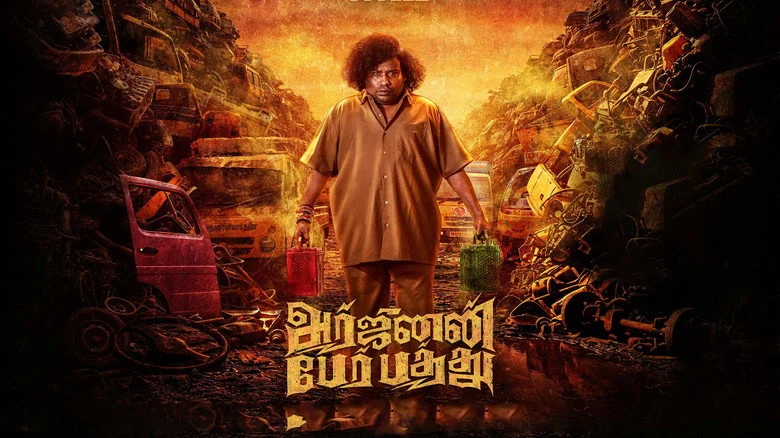
Yogi Babu’s Grievance Arc Carries More Weight Than His Gags Ever Did
Yogi Babu has built a career on timing, but here he’s asked to trade punchlines for pathos. The role demands a sustained mix of hurt and stubbornness, particularly in the sequence where he watches his hard-earned Tata Ace break down repeatedly, each failure chipping away at his dream. He manages the shift from victim to investigator with a restraint that suggests he’s been waiting for a part that takes him seriously.
His arc is grievance-driven, moving from personal loss to collective action, and the film wisely lets him play the process rather than the result. There’s no grandstanding in his performance, just the quiet fury of a man who realizes he’s been treated as a fool.
Rajmohan’s Screenplay Prefers a Linear March to Dramatic Surprise
Rajmohan’s direction is built around a socially rooted, issue-based narrative with a clear real-world target. The structure is linear, setup, betrayal, investigation, exposure, which gives the story a procedural clarity that suits the subject matter.
The flaw is that this clarity borders on predictability. The early melodramatic setup around the parental death feels like a shortcut to sympathy, and the film never quite recovers from that tonal overreach. One wishes the screenplay trusted its core premise enough to skip the tragedy preamble entirely.
Still, there’s craft in how the script expands the conflict from a private dispute into a public-fraud problem. The victim-network angle is where the film finds its purpose.
The Genre’s Social-Justice Endpoint Is the Film’s Only Real Destination
As a drama, Arjunan Per Paththu operates on a grievance-and-redress structure that is familiar but effective. The film centers on ordinary consumer vulnerability rather than spectacle, which gives it a realism that commercial Tamil cinema often avoids. The failed Tata Ace purchase and its repeated breakdowns are the film’s most honest moments, they show the fraud mechanism in action, not just in dialogue.
The scam-exposure segment, where Arjunan unites other victims and turns the fraud into a public confrontation, is the film’s most praised scene. It works because it shifts the genre’s focus from individual suffering to collective resistance, a move that elevates the material beyond a simple revenge tale. The final exposure of the scam delivers the social-justice endpoint the genre promises.
The film’s weakness lies in its inability to sustain tension between these beats. The middle act drags as Arjunan traces the fraud’s wider pattern, and the procedural investigation lacks the urgency that a tighter edit might have provided. The premise is socially relevant, but the execution doesn’t always match the ambition.
Kaali Venkat and Lenin Bharathi Anchor the Victim Network
Kaali Venkat’s presence signals a grounded, naturalistic performance style, and his casting suggests the film intends to treat the victim-network sections with seriousness. He brings a lived-in quality to the ensemble, even if the available material doesn’t specify his exact role in the investigation.
Lenin Bharathi is listed as playing a pivotal role, and his inclusion in the cast adds weight to the procedural sections. The film’s ensemble structure supports the exposé format, with actors like Mynaa Nandhini and Aruldoss filling out the victim pool. I suspect the film’s real strength lies in how this collective functions as a single character, the wronged consumer, rather than in any individual supporting turn.
For more on how Tamil cinema handles everyday battles, browse more Tamil Drama reviews.
The Awareness Angle Is the Film’s Only Shield Against Criticism
Arjunan Per Paththu has no verified controversy attached to it, and none is needed, the film’s political angle is baked into its premise. By framing used-vehicle fraud as a systemic issue that hurts ordinary buyers, Rajmohan positions the film as consumer advocacy rather than pure entertainment. This awareness-oriented approach gives the story a practical purpose, but it also risks alienating viewers who come expecting commercial drama.
The film is likely to appeal to fans of issue-based cinema and families who appreciate a clear moral compass. Those looking for action-heavy spectacle or tonal variety should look elsewhere, this is a straight-faced drama that rarely wavers from its mission. The target audience profile suggests a class-and-family lean, which makes sense for a film that wants to educate as much as entertain.
Arjunan Per Paththu is a film that knows exactly what it wants to say, even if it doesn’t always know how to say it with cinematic flair. The premise is relatable, the lead performance is sincere, and the collective-exposure structure gives the story a purpose beyond mere entertainment. Watch it for Yogi Babu’s serious turn and the film’s genuine concern for consumer rights, but adjust your expectations for dramatic intensity.
If you’re in the mood for a film that tackles fraud with the same earnestness, check out how Ikka review.
Arjunan Per Paththu is a sincere, issue-driven drama that earns a 2.5/5, worth a watch for Yogi Babu’s committed performance, but not a film that will linger long after the credits roll.
For a lighter take on Tamil comedy-dramas, see how Dhamaal 4 verdict.

Ankit Jaiswal is the Chief Author, covering Indian cinema and OTT releases with honest, no-filler criticism. An SEO strategist by background, he brings a research-driven approach to film writing, cutting through hype to tell you exactly what's worth your time.