Indian Institute of Zombies (2026): A Promising Premise That Bites Off More Than It Can Chew
At Tekfest 2026, Dr. Darwendra holds up a shimmering potion before the institute’s elite toppers, promising superpowers and immortality. The students drink, and within seconds, their eyes glaze over, their jaws slacken, and the campus’s brightest minds transform into flesh-craving monsters. It’s a deliciously wicked setup, academic meritocracy literally consuming itself, that announces a satire with real teeth. Unfortunately, those teeth never quite sink in deep enough.
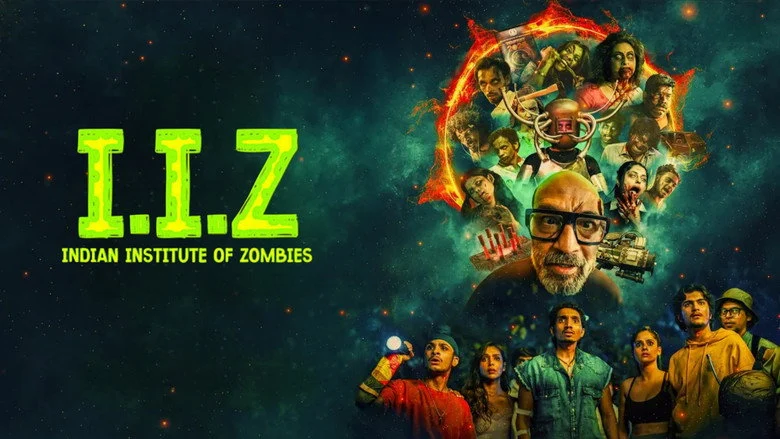
Mohan Kapur’s Doctor Delivers Menace Without a Pulse
Mohan Kapur’s Dr. Darwendra is the film’s central engine, a manipulative scientist exploiting student ambition for his own grand scheme. He’s less a conventional monster and more a deceptive authority figure, which makes him conceptually interesting. Kapur brings a controlled menace to the role, suggesting a man who believes his contagion is a form of progress.
His performance carries the film’s dramatic weight, but the script gives him little to work with beyond the initial deception. The character’s threat is both physical and institutional, since his plan ties campus prestige to mass contagion. Yet the payoff feels rushed, with Kapur’s potential underutilized in the chaotic final stretch.
Direction and Screenplay: A High-Concept Setup Loses Its Way
Gaganjeet Singh and Alok Kumar Dwivedi demonstrate a clear vision for the high-concept setup, using the prestigious engineering institute as an immediate social frame. The campus backdrop is smartly deployed, it creates visual contrast between academic order and zombie chaos. The first half moves efficiently from Tekfest setup to outbreak trigger.
But the screenplay, written by Hussain Dalal and Abbas Dalal, struggles to hold its tonal balance. India Today’s 2.0 rating captures the consensus that “weak writing and tonal confusion” undermine the film’s promise. The satire on academic hierarchy gets diluted as the film shifts into generic survival mode, with jokes landing unevenly against horror beats.
Genre-Core Execution: Horror That Stumbles Into Comedy
The outbreak is triggered by a deceptive science experiment, a standard horror catalyst that works effectively within the campus setting. The transformation of toppers into zombies provides the film’s primary horror payoff, and the contained-siege format keeps the threat focused initially. The story escalates from individual infection to potential citywide contagion, giving the narrative a clear stakes ladder.
The Tekfest 2026 potion sequence is the film’s most praised moment, converting an academic event into a horror incident with genuine wit. Watching the so-called best students become the first casualties of their own ambition carries a sharp satirical edge. It’s the one scene where the premise and execution align perfectly.
But the campus resistance sequences, led by Professor Breganza and the backbenchers, reveal the tonal cracks. The comedy beats feel weakly written, and the horror loses its tension whenever the film tries to be funny. Reviewers described the genre blending as uneven, and that assessment holds, the film never commits fully to either register.
Supporting Cast Anchors the Survival Narrative
Anupriya Goenka’s Professor Breganza emerges as the resistance leader, grounding the survival portion of the story with credibility. Her presence alongside the student survivors gives the film a much-needed authority figure who isn’t corrupt. Goenka’s casting signals the film’s intent to balance institutional critique with genuine heroism.
Sachin Kavetham’s Rambo and Tanishq Chaudhary’s Harjas Singh represent the backbenchers who miss the contaminated event entirely. Their outsider perspective, avoiding the trap that catches the ambitious, is the film’s sharpest comic inversion. Both actors bring a scrappy energy that the film could have used more of in its muddled middle sections.
The supporting ensemble around them fills out the campus population, though most characters remain thinly sketched. The film’s concept of backbenchers as unlikely survivors gives the story a clear comic direction, even if the execution doesn’t fully sustain it.
Audience Reception: A Cult Idea Searching for Its Film
The premise of a zombie outbreak in an Indian engineering campus has genuine appeal, drawing in younger horror-comedy audiences and viewers interested in campus satire. Social media chatter has focused on the film’s clever concept, toppers versus backbenchers as a survival dynamic, even as complaints mount about screenplay coherence and inconsistent tonal balance. This is a film for fans only, not casual viewers expecting polished genre craft.
Critics have acknowledged the film as a “potentially fun zombie comedy” while noting that execution never matches concept strength. The institute backdrop allows social commentary on privilege and competition, but the satire gets buried under uneven momentum in the second half. The film’s self-contained survival scenario works in theory; the problem is that the journey from outbreak to counterattack never finds its rhythm.
For a horror-comedy with an A certificate and a 137-minute runtime, the pacing drags noticeably in the survival phase. The editing creates a clear split, setup-driven first half, containment-focused second half, but the latter loses steam. What remains is a film with admirable ambitions and frustrating execution.
If you’re curious about how Indian cinema tackles zombie satire within a campus context, this is worth a watch on OTT when it lands there. The premise deserves better than it gets, but there’s enough conceptual spark to satisfy genre completists. Regular theatrical viewing isn’t necessary; wait for streaming, where the film’s flaws feel less punishing.
Browse more Hindi Horror reviews to see how other films handle genre blending.
IIZ: Indian Institute of Zombies is a concept in search of a screenplay, earning 2 out of 5 stars for its sharp premise and muddled execution, a potentially fun zombie comedy that never quite wakes up.
For another campus-set genre experiment that struggles with tone, check out Angam Attahasam review.
If you prefer satirical premises that run out of fuel, explore Dug Dug verdict.

Ankit Jaiswal is the Chief Author, covering Indian cinema and OTT releases with honest, no-filler criticism. An SEO strategist by background, he brings a research-driven approach to film writing, cutting through hype to tell you exactly what's worth your time.