Battle (2026): A Tamil Rap Drama That Finds Its Voice Only in Flashes
There is a moment early in Narayanan P’s Battle when Arjun Prabhakaran’s Mani, born mute until age ten, first lets the rhythm take over, a transformation that signals the film’s most potent idea: that music is survival made audible. The premise is promising, a street rapper in north Madras navigating love, institutional abuse, and the weight of his own art, but the execution stumbles where it matters most.
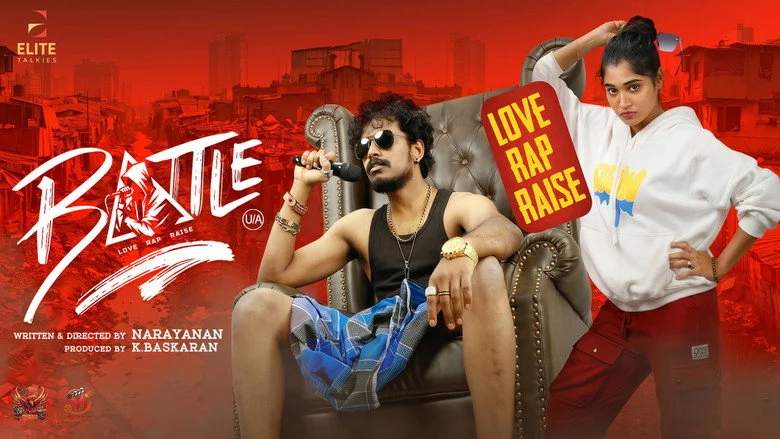
Arjun Prabhakaran’s Silent Arc Speaks Louder Than His Verses
Prabhakaran carries the film on a performance built from restraint. His Mani is a character defined by what he cannot say, and the actor leans into expressive internal conflict rather than dialogue-heavy declarations.
The mute-to-rapper journey gives him a visible arc, but the second half demands emotional collapse, and he delivers the breaking point with more conviction than the rise. It is a committed turn in a film that does not always match his intensity.
Aradhya Krishna Anchors the Social Conscience
As Madhi, the schoolteacher battling an abusive administration, Aradhya Krishna provides the film’s moral and romantic counterweight. Her scenes carry the weight of institutional pressure, grounding Mani’s artistic turmoil in something tangible.
Subramaniam Siva and Munishkanth fill out the ensemble, though neither is given material that rises beyond functional support. The casting signals a community-driven framework, but the screenplay rarely lets these figures breathe. Diviyadharshini Uma and Saravana Subbiah remain peripheral, their presence felt more than their characters defined.
The Drama’s Core: A Familiar Rise, An Uneven Fall
Narayanan P’s direction has a clear conceptual focus, rap as identity, love as complication, and social conflict as the crucible. The film’s best instinct is treating performance not as decoration but as a character-identity device, tying Mani’s growth directly to the pressure around him.
Yet the middle stretch loses momentum, with the romance and the school-administration conflict colliding at an uneven pace. The linear rise-fall-rise structure feels worn, and the screenplay’s reliance on a familiar underdog template undercuts the freshness of its premise.
The crisis section, where Mani is pushed to the edge, works in flashes rather than as sustained drama. The thematic resolution, art finding meaning beyond fame, lands with sincerity, but the journey there is bumpier than it should be.
For more on how Tamil cinema handles similar terrain, browse more Tamil Drama reviews.
Direction and Screenplay: Strong Intent, Weak Follow-Through
The film’s conceptual ambition is admirable, connecting music to social pressure rather than letting rap exist as a standalone flourish. That choice gives Battle a defined identity within the Tamil rap drama space.
But the execution is inconsistent. The second half slows under the weight of romance and conflict, and the editing does little to tighten the sagging middle. The opening establishes Mani’s history at a steady pace, yet the film never recovers that rhythm once the crisis sets in.
The Box Office Reality and Audience Verdict
The numbers tell a brutal story. Opening at ₹0.05 crore and closing its first week at ₹0.19 crore net in India, per tenvow.com, against an estimated ₹3 crore budget, Battle was declared a flop before its second weekend. The IMDb rating of 5.0, though based on a single vote, reflects the muted response.
There are no political controversies or censorship battles here, just a film that could not find its audience beyond a localized one. The social angle through Madhi’s workplace struggle earned some praise, but complaints about pacing and limited scale dominated the conversation.
Mani’s journey from silence to rap is the film’s most compelling thread, but it is wrapped in a narrative that never fully commits to its own stakes. The romance feels rushed, the antagonist Uriyadi Suruli functions more as institutional pressure than a memorable presence, and the crisis resolution, while sincere, arrives after too much uneven buildup.
For a film about finding one’s voice, Battle spends too much time unsure of its own. If you are invested in Tamil rap culture or the underdog drama template, there is enough here to warrant a casual watch, but manage expectations. The best format is a regular theatrical screening, preferably with a patient crowd.
Battle is a film with a beating heart and a faltering pulse, a 2.5/5 effort that will leave you respecting its intentions more than its execution.
If you are drawn to uneven romantic dramas with social undertones, Ginny Wedss review offers a similar struggle with repetitive scripting.
For a sharper take on regional drama with darker undertones, Bharathanatyam 2 verdict delivers what Battle reaches for.

Ankit Jaiswal is the Chief Author, covering Indian cinema and OTT releases with honest, no-filler criticism. An SEO strategist by background, he brings a research-driven approach to film writing, cutting through hype to tell you exactly what's worth your time.