Maragatha Malai (2026): The Forest Swallows stands out while the narrative loses grip
Deep into the 18th-century woods, a fleeing mother is separated from her child, and the screen shifts from human panic to something colder, a curse, a statue, a ghostly presence. It is the single most evocative image in Maragatha Malai, and it arrives early, promising a fable the rest of the film never quite matches. From that moment, you know exactly what kind of ride this is: a simple, earnest fantasy for families, not a complex drama for cynics.
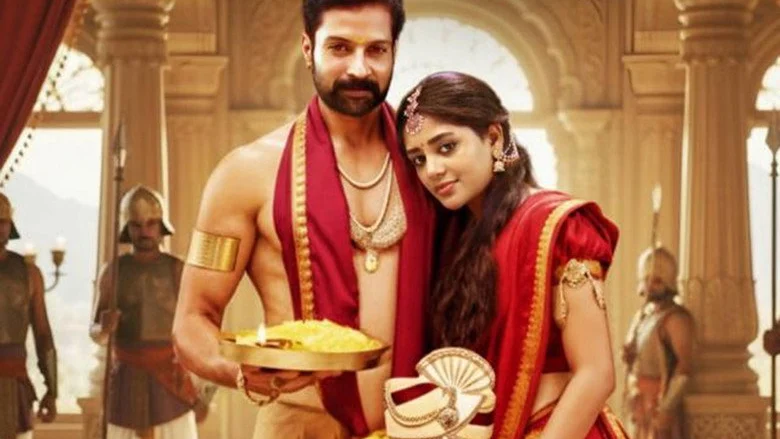
Santhosh Prathap Plays the Protector, Not the Tormented Hero
As zamindar Parthiban, Santhosh Prathap is less a layered dramatic lead and more a pillar of paternal resolve. He carries the search-and-separation arc with a steady, unflashy presence that suits the film’s mythic register. His best work comes in the reunion-oriented scenes, where his restraint makes the emotional payoff land without melodrama. It is a functional performance, but it never risks the kind of vulnerability that would elevate the material.
Prathap’s casting signals the film’s intent: this is a hero defined by duty, not interiority. I found myself wishing the script gave him one moment of genuine doubt to complicate the archetype.
A Linear Screenplay That Values Clarity Over Surprise
Director S. Lathha maintains a clean, linear structure that keeps the family-reunion objective visible from start to finish. The opening attack by dacoits and the subsequent forest escape establish the stakes efficiently, and the treasure-map device is a classic adventure hook. The strength here is accessibility, a child can follow this plot without strain, which is clearly the intent.
The weakness is equally clear: the middle section, dominated by the sorcerer and his helpers, settles into repetitive fantasy conflict. The pacing drags noticeably, and the predictable development of the sacrifice-threat climax feels more like a checklist than a crescendo. Lathha’s direction is competent but never inventive, relying on familiar genre beats when the narrative needs a jolt.
The Fantasy Mechanics Work, Until They Don’t
Maragatha Malai commits to its genre identity with a consistency that deserves credit. The period setting is established firmly, and the magical elements, curses, flying creatures, supernatural transformations, create a coherent world where the rules are simple but respected. The forest separation and curse sequence is the film’s strongest stretch, demonstrating a genuine feel for fable-like storytelling.
The adventure component is built on a straightforward good-versus-evil axis, with the dacoits and sorcerer’s servants providing clear physical threats. The climactic confrontation around the son’s threatened sacrifice carries real stakes, even if the choreography of the resolution feels rushed. For younger viewers, this will read as thrilling; for seasoned genre fans, it is serviceable.
The drama layer, however, is where the film falters. The emotional driver, family separation and reunion, is sincere but thinly scripted, with the mother’s transformation into a statue-like presence reducing a key character to a plot device. The film’s effects-driven scenes are not consistently polished, and the fantasy imagery, while ambitious for a low-scale production, occasionally strains against its budget.
Thambi Ramaiah and Jagan Anchor the Supernatural Threat
Thambi Ramaiah and Jagan are positioned not as realistic villains but as supernatural antagonistic forces, and they commit fully to that register. Ramaiah’s presence adds a layer of theatrical menace to the sorcerer’s scenes, while Jagan drives the chase and sacrifice portions of the second half with a physicality that keeps the adventure stakes alive. Their casting is a smart choice, both actors understand the fable-like tone and never try to ground it in realism that would clash with the fantasy framework.
Deepshika Umapathy, as the wife Gayathri, carries the emotional weight of the separation arc, and her tie to the curse and forest transformation gives the film its most haunting imagery. The supporting ensemble, including Kalaikko Varman, functions within the broader framework rather than standing out individually, which is a limitation of the script’s functional approach to characterization.
A Family Film With a Clear Audience, and Clear Limits
CinemaSpeak.in rates the film 3.25/5, a fair assessment that captures its strengths and ceilings. The publication notes it is “a fantasy adventure, mainly for kids and family audiences, ” which is an accurate framing of its intent. There is no reported controversy here, and the film’s political angle is nonexistent, this is purely a good-versus-evil tale meant for younger viewers and their parents.
What Maragatha Malai does well is keep its premise focused on family reunion and inheritance, using a clearer fantasy setup than many low-scale period dramas. What it does worse is develop its middle section with any novelty, depending on familiar devices rather than fresh narrative turns. The audience complaints mirror the critical ones: predictable plot, uneven pacing, and low-detail character arcs outside the central family. For its target demographic, this is a serviceable matinee; for anyone else, it is a test of patience.
For more stories like this, browse our Tamil Drama reviews.
The Verdict: A Simple Fable for the Family Matinee Slot
Maragatha Malai is best watched with the expectation of a children’s storybook brought to screen, simple, sincere, and unbothered by complexity. If you are a parent looking for a clean fantasy adventure with a clear moral spine, this will do the job. If you are a cinephile seeking craft or narrative innovation, look elsewhere. The best format is a regular theatrical screening with kids, where the film’s earnestness will land best.
Maragatha Malai (2026) is a well-intentioned but predictable fantasy that earns a modest 2.5/5 for its family-friendly sincerity and unambitious execution.
For a similar family-reunion arc with more emotional heft, check out Neelira review.
If you prefer fantasy premises with stronger narrative follow-through, Oru Durooha verdict offers a sharper contrast.

Ankit Jaiswal is the Chief Author, covering Indian cinema and OTT releases with honest, no-filler criticism. An SEO strategist by background, he brings a research-driven approach to film writing, cutting through hype to tell you exactly what's worth your time.