Aakhri Sawal (2026): The Thesis Rejection stands out while the narrative loses grip
Professor Gopal Nadkarni (Sanjay Dutt) publicly tears apart his research scholar’s thesis on the RSS, and in that single moment, a quiet academic dispute detonates into a very public ideological war. Vicky (Namashi Chakraborty) refuses to back down, turning what should have been a campus conversation into a televised spectacle that grips the nation. The setup promises intellectual combat, but what follows is a film that mistakes volume for conviction.
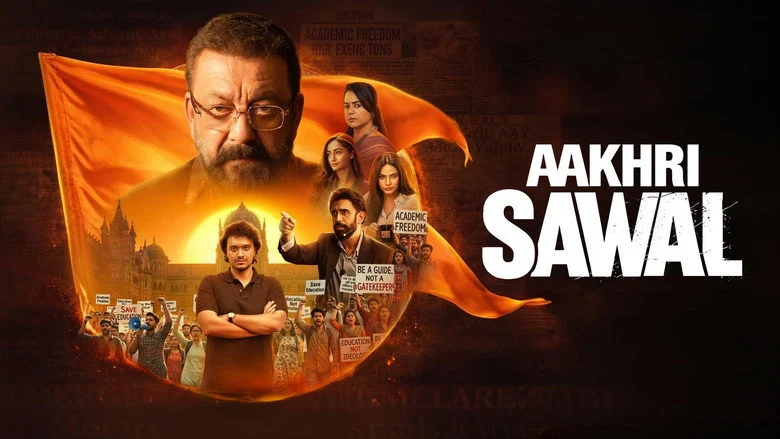
Sanjay Dutt Commands the Frame But Finds No Counterweight
Dutt is the engine here, and his scenes anchor the debate-heavy structure with forceful delivery. He is at his best in confrontation-driven passages where his physical authority and gravel-toned righteousness give Gopal Nadkarni a compelling, if one-dimensional, weight. The actor’s presence repeatedly papers over the screenplay’s lack of restraint, making the professor feel more formidable than the words he is given.
Namashi Chakraborty’s Vicky functions as the catalyst, pushing the dispute from seminar rooms to prime time. Yet the antagonist’s positioning feels lopsided; the film never grants Vicky the intellectual sophistication needed to make this a genuine clash of equals. One review noted the film “does not know the meaning of subtlety, ” and Chakraborty’s performance suffers most from that approach, reducing a promising scholar to a mouthpiece for overt dramatic excess.
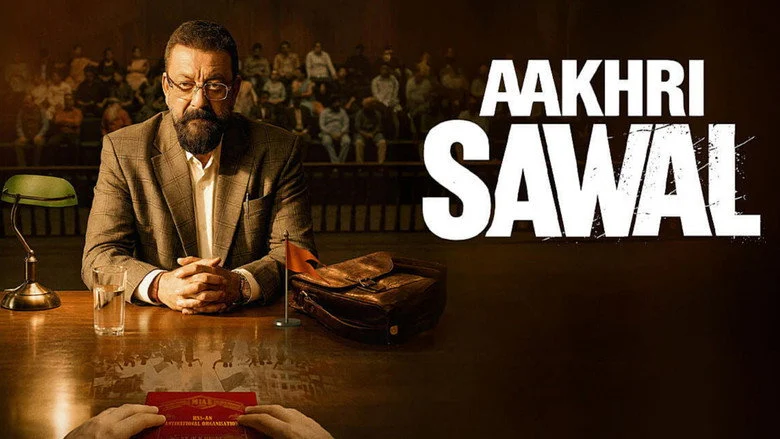
The Debate Structure Drives Momentum, But at the Cost of Nuance
The film’s central engine is the televised debate, and director Abhijeet Mohan Warang clearly knows how to stage these sequences. The second-half confrontation, where Vicky pushes toward flashpoints like the Gandhi assassination and the Emergency, sustains tension and keeps the focus razor-sharp. This is where the political drama works, using public escalation to transform a private grievance into an institutional reckoning.
However, the craft collapses whenever the film steps away from the debate floor. Multiple critics flagged the one-sided framing, with one publication calling it an “RSS whitewash piece” that engages in “narrative-building without nuance.” The screenplay by Utkarsh Naithani leans on explicit dialogue and dramatic escalation instead of trusting the audience to parse competing claims. The first half, in particular, drags through setup that telegraphs every ideological beat.
Warang’s direction keeps a single conflict at the center, which is disciplined, but his refusal to lower the dramatic temperature undermines the very intellectualism the film claims to celebrate. The most criticised scenes are those heavy-handed exchanges where the film’s thesis is shouted rather than argued. A cross-publication average of 2.5/5 reflects this frustration with a project that had the bones of a sharp political thriller but the temperament of a soap opera.
For more political dramas that handle ideological conflict with sharper writing, browse more Hindi Thriller reviews.
Amit Sadh and Sameera Reddy Serve the Machine, Not the Story
Amit Sadh plays the news anchor who accelerates the academic dispute into a national trial, and his casting signals the film’s media critique. He moves the plot efficiently from campus to studio, but the character never develops beyond his function as an escalation device. Sadh does what he can with a role that exists purely to amplify the noise.
Sameera Reddy’s political activist adds pressure to the debate structure, representing the ideological forces circling the central confrontation. Her presence widens the frame beyond the two men, but the screenplay keeps her tethered to the film’s one-sided argument. Both actors are competent, yet they are ultimately casualties of a script that prizes confrontation over character. Dutt reportedly produced the film alongside Nikhil Nanda, which may explain why the narrative tilts so heavily toward his professor’s perspective.
A Political Firestorm With No Box Office Heat
The film’s release was framed around its RSS-centered narrative, drawing strong ideological reactions from both sides of the political spectrum. Review coverage repeatedly accused the film of narrative-building without balance, and the controversy did little to drive audiences to theaters. The opening day collected a modest ₹0.40–0.48 crore in India, with worldwide gross at ₹0.63 crore, per Republic World and Koimoi tracking.
First-week figures from Bollywood Hungama and Sacnilk showed India net at ₹2.45–2.90 crore and worldwide gross of ₹3.02–3.60 crore, numbers that trade analysts described as underperforming. The film was eventually declared a flop, with no sustained box office traction despite the political heat it generated. This is a case where the debate outside the theater proved more compelling than the one on screen.
What remains is a film that keeps you hooked through its confrontational pacing, as one review noted it “does not allow a single dull moment.” But engagement is not the same as enlightenment. I found myself wishing the film trusted its audience to handle ambiguity, rather than hammering every point home twice. For fans of political dramas who enjoy extended debate sequences, there is something here; for those expecting the subtlety of a well-argued thesis, this is a lecture you have heard before.
Sanjay Dutt powers this political drama with undeniable force, but Aakhri Sawal never lowers its voice long enough to say anything truly meaningful. If you are a fan of the actor’s presence, a theatrical or OTT viewing works fine, though no format will add the nuance the script lacks. The film earns a modest 2.5 out of 5 for its gripping debate sequences and Dutt’s commanding performance, but it is a miss for anyone seeking balanced, intellectually rigorous political storytelling.
For a sharper take on ideological conflict in a courtroom setting, consider Pati Patni review.
If you prefer your political dramas with more crowd energy and less heavy-handed dialogue, Athiradi verdict offers a different kind of confrontation.

Ankit Jaiswal is the Chief Author, covering Indian cinema and OTT releases with honest, no-filler criticism. An SEO strategist by background, he brings a research-driven approach to film writing, cutting through hype to tell you exactly what's worth your time.