Inkosari – Chapter 1 : Rewind (2026): Shashank and Rugved keeps the film tense but uneven overall
A Telugu mystery wrapped in shadow and ellipsis unfolds across incomplete frames, Inkosari – Chapter 1: Rewind constructs its world from what it withholds rather than what it reveals. Dialogue cuts through with sharp vernacular, hinting at drug addiction, moral collapse, and a backstory deliberately buried, leaving viewers suspended in the murky space between revelation and obfuscation.
This is a film that knows exactly what it is doing, and will test whether you’re willing to follow.
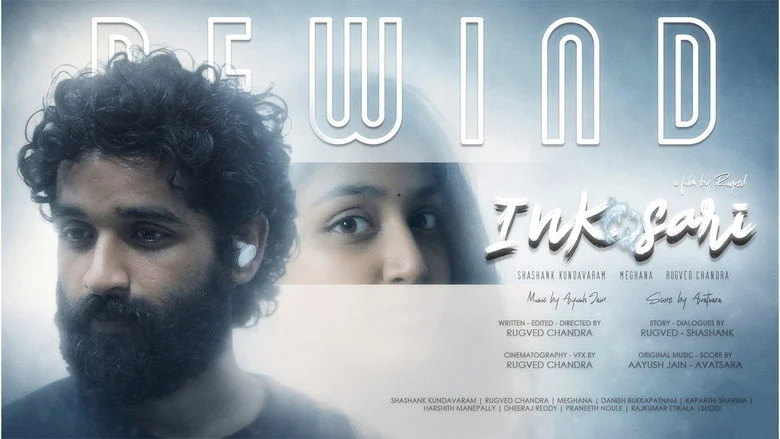
Shashank and Rugved Navigate a Narrative Deliberately Left Incomplete
The cast carries weight through sparse information, forced to anchor a story that resists anchoring. Shashank and Rugved work within a structure that privileges absence over presence, where character trajectories emerge through implication rather than exposition. Their performances operate in this restricted space, suggesting depths that the screenplay refuses to fully excavate, a choice that either marks bold restraint or frustrating underutilization.
Screenplay as Structural Gamble: Answers Lag Deliberately Behind Questions
The chapter-driven narrative is Inkosari’s foundational risk and its primary weakness. Operating in murky territory by design, the screenplay builds on ellipsis, narrative incompleteness treated as feature rather than flaw. This demands viewers wait for the full cycle before determining if the fragmentation serves the story or merely postpones it.
The gamble is audacious but unproven. Questions accumulate without resolution, and whether this generates intrigue or frustration depends entirely on the viewer’s tolerance for deferred closure. Sharp Telugu vernacular anchors what clarity exists, but it’s never quite enough to settle the film’s core intentions.
Mystery Through Murky Frames: Genre Operating at the Edges
The mystery structure here refuses conventional clarity. Incomplete frames mirror incomplete narrative architecture, the visual language echoes the screenplay’s resistance to easy answers. Every withholding, from dialogue to cinematography, reinforces that this is a film skeptical of resolution.
The thriller elements remain shadowed. Crime drama textures emerge in the dialogue’s moral weight, in references to addiction and collapse, but they’re never clarified into plot mechanics. Instead, they float as thematic suggestions, asking what the story is really investigating without committing to answers.
This approach either deepens engagement through mystery or fragments it through incompleteness. For viewers accustomed to three-act resolution, Inkosari operates as provocation rather than narrative delivery, a choice that feels deliberately confrontational with audience expectation.
Those seeking Telugu mystery narratives that demand active interpretation will find something worth excavating within this structure.
A Film Aware of Its Own Risk: Critical Reception at 2.5/5
Critical consensus settles on cautious skepticism. The film registers as exactly what it announces, a narrative constructed to frustrate linear viewers while rewarding those willing to tolerate incompleteness as artistic choice. A 2.5/5 rating reflects this fundamental divide: the score itself becomes a verdict on whether the risk was justified.
Unreleased, Embargoed, or Deliberately Obscure
The scarcity of production details, the absence of director credit, and the minimal cast information suggest either a film still under embargo or one positioned deliberately outside conventional industry machinery. This opacity mirrors the narrative’s own withholding strategy, the film’s mystery extends to its own making.
Viewers curious enough to pursue this will encounter a structure that respects their intelligence while testing their patience. I suspect Inkosari knows its audience isn’t the mainstream, it’s built for those willing to sit with ambiguity and defer judgment until the full chapter cycle completes.
If you’re drawn to Telugu mystery narratives that refuse easy answers and demand active interpretation across multiple installments, this warrants attention. If you require closure and narrative clarity within a single film, wait for the complete cycle or skip entirely. The format matters less than your willingness to inhabit incompleteness.
Inkosari – Chapter 1: Rewind is a deliberately fragmented mystery that operates as provocation more than story, earning its cautious 2.5/5 rating through ambition that outpaces execution.
Similar Telugu narratives operating in ellipsis and shadow appear in Thimmarajupalli TV review, which also gambles on withholding as narrative strategy.
Films like Bad Boy verdict share this tension between character restraint and audience expectation.

Ankit Jaiswal is the Chief Author, covering Indian cinema and OTT releases with honest, no-filler criticism. An SEO strategist by background, he brings a research-driven approach to film writing, cutting through hype to tell you exactly what's worth your time.