Bad Boy Karthik (2026): Naga Shaurya’s Protective Instinct Familiar but Earnest
Karthik moves through the world with fists ready and conviction burning, a rowdy brother shadowing his sister Kasturi, a lawyer who takes on powerful men draining farmers dry. The premise arrives pre-worn, a formula that Telugu cinema has visited often, yet Naga Shaurya steps into the role with the kind of committed physicality that suggests the actor understands what’s being asked of him, even if the material rarely surprises.
Ramesh Desena’s direction settles into familiar grooves without fighting against them. The film operates as an action-comedy-drama hybrid that never truly commits to any single lane, mixing setpieces with sentiment and humor without the structural confidence needed to make such tonal multiplicity sing. What emerges is competent but unmarked, serviceable filmmaking that executes without distinction.
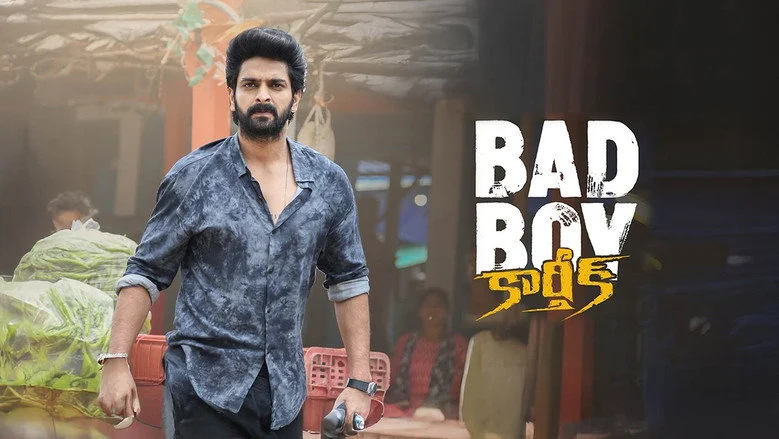
Naga Shaurya Inhabits Protective Loyalty Rather Than Creating It
Shaurya’s Karthik channels the archetype of the brother-as-fortress with genuine physical commitment. He plays the character not as an invention but as an inhabitation, understanding the emotional stakes beneath the rowdy exterior, finding gravity in scenes where Kasturi’s legal battles collide with his street-level solutions.
The actor delivers the emotional tether the film depends on, grounding material that could have slipped into parody. His intensity in moments of familial protection reads as authentic rather than performed, which matters considerably when the screenplay offers little else to distinguish this story from a dozen others wearing the same DNA.
Desena’s Direction Executes Without Risk or Precision
The filmmaker constructs scenes with workmanlike efficiency, nothing feels broken, yet nothing feels discovered either. The screenplay follows the most obvious path through every narrative junction, presenting the righteous sister and rowdy brother dynamic as fait accompli rather than exploring what makes their specific bond meaningful.
What surprises me is how the film resists its own potential: the intersection of legal justice and street justice could generate real friction, but instead the two systems align too cleanly, robbing the story of ideological tension. The direction never interrogates this space; it merely decorates it.
Action Grammar Delivered Without Cinematic Language
Karthik takes law into his own hands to protect his sister, and the action sequences follow this principle with predictable staging. The choreography arrives functional, punches land, frames clear, geography reads, but without the spatial imagination or rhythmic precision that transforms setpieces from combat into cinema.
The comedy sits uneasily alongside these sequences, neither amplifying the action’s absurdity nor standing apart as genuine humor. Scenes oscillate between tones without transition, treating dramatic revelation and comedic release as interchangeable beats rather than distinct emotional registers.
Harris Jayaraj’s background score aims for emotional scaffolding across these tonal shifts, yet the fundamental problem remains structural: the film mixes registers that require sharper writing to cohere. The action framework itself, brother as protector, farmer exploitation as injustice catalyst, feels borrowed from a library of Telugu action templates rather than reimagined through Desena’s perspective.
Sridevi Vijayakumar as Kasturi carries the thematic weight as the lawyer fighting injustice, embodying the film’s social conscience through her character’s courtroom conviction. Her casting signals the film’s intent to anchor emotional legitimacy in the sister’s moral clarity, yet the screenplay rarely gives her scenes that operate independently of Karthik’s protective shadow.
Familiar Narrative Mechanics Offer No Political Interrogation
The film’s engagement with farmer exploitation and institutional corruption stays at surface level, presenting injustice as backdrop rather than examining systems. This choice, to treat social issues as motivation rather than true subject, limits the film’s reach and coherence as a drama.
What might have distinguished this story, exploring how legal and extra-legal justice intersect, when vigilantism becomes necessary, what cost protection exacts on both protector and protected, remains unexamined. The film presents conflict without exploring its dimensions.
Telugu Action Cinema Continues a Pattern This Film Cannot Escape
Bad Boy Karthik follows a well-worn path that has served Telugu cinema for decades: the righteous outsider fighting institutional corruption through physicality. Yet without distinctive craft or thematic innovation, the film becomes another entry in a crowded archive rather than a statement within it.
Naga Shaurya’s commitment deserves a vehicle that challenges him beyond embodying conviction. Harris Jayaraj’s score attempts emotional scaffolding the screenplay hasn’t earned. The result feels like several competent films layered atop each other without integration, action without discovery, comedy without timing, drama without interrogation.
If you’re seeking Telugu action-drama comfort food with an actor who understands his material, this delivers exactly that level of entertainment without aspiring further. The 2 hour 22 minute runtime suggests filmmaking aware of its own limitations, at least.
Bad Boy Karthik is a case of capable execution in service of uninspired material, Naga Shaurya deserves better, and Telugu cinema has demonstrated it can do this story with far greater cinematic precision at 3.0 out of 5 stars.
Telugu action reviews at FilmyFly4K examine how the genre continues evolving through familiar structures and fresh approaches.
The same structural DNA that constrains this film appears in Raakaasa review, where genre convention outweighs character invention.
Both G O verdict and Bad Boy Karthik demonstrate how formula can either constrain or clarify a story, depending on execution depth.

Ankit Jaiswal is the Chief Author, covering Indian cinema and OTT releases with honest, no-filler criticism. An SEO strategist by background, he brings a research-driven approach to film writing, cutting through hype to tell you exactly what's worth your time.