

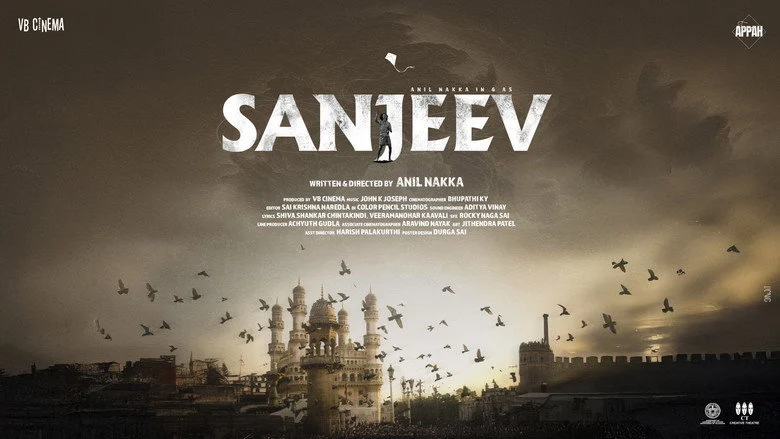
Sanjeev opens with a man who seems to be carrying more than his own shadow. Anil Nakka, who also directs, plays the titular character with a stillness that suggests a lifetime of suppressed conflict. He does not perform the pain; he lets it sit in his posture and his pauses.
His scenes with Veeramanohar Kavali, who plays Shiva, reveal a dynamic that feels lived-in rather than written. Nakka understands that in a social drama, the lead’s job is to be a mirror, not a megaphone. He succeeds more often than he falters.
A Director’s Double Duty: Clarity Over Flash
As a director, Nakka shows a clear preference for honesty over spectacle. He frames conversations in static shots, forcing the audience to listen rather than just watch. This is a strength, as it keeps the film grounded in a reality that often escapes bigger productions.
However, the screenplay suffers from a lack of narrative urgency in the middle act. The pacing dips where it should tighten, leaving certain emotional beats to rely on the actors’ goodwill rather than the writing’s momentum.
The Social Drama’s Core: Patience as a Virtue
The genre demands a slow burn, and Nakka commits to that with discipline. He avoids the typical Telugu film tropes of melodrama and loud confrontation, choosing instead to let the quiet moments breathe. The conflict is internal, simmering beneath the surface of everyday interactions.
Harish Palakurthi, as the character Harish, provides a necessary counterpoint to the lead’s intensity. His presence offers a semblance of normalcy in a world that feels increasingly heavy for Sanjeev. The film’s craft is in these small, observational details.
Yet, the lack of a defined antagonist leaves the narrative drifting at times. The “system” or “society” is the implied villain, but it never materializes into a tangible obstacle. This makes the climax feel more like a resignation than a resolution.
Supporting Cast: The Anchors of Reality
Laya Miryala, as Pallavi, brings a quiet strength that is essential to the film’s emotional core. Her moments with Nakka are tender without being saccharine, giving Sanjeev a reason to fight that feels organic. She grounds the film’s more abstract themes in a tangible relationship.
Achyuth Gudla as Venkat rounds out the ensemble with a performance that signals the film’s intent to portray a community, not just a protagonist. The casting choices suggest a deliberate move towards authenticity, prioritizing naturalism over star power. This choice pays off, as the ensemble feels like a real social circle rather than a collection of actors.
Audience Reception: A Matter of Patience
This is a film that will test the patience of viewers conditioned to expect a payoff every fifteen minutes. There is no box office data available to gauge its commercial reach, but the word-of-mouth will likely be split. Those seeking a contemplative character study will find much to admire here.
The film’s lack of controversy is itself a statement; it is a work that tries to speak to a universal human condition rather than a political moment. It asks for a specific kind of viewer, one who values the texture of a moment over the speed of a plot. For that audience, the film offers a rare commodity: respect for their intelligence.
For more films that prioritize the quiet details of human behavior, browse our Telugu Drama reviews.
Sanjeev is not a film for everyone, but it is a film for someone. If you are willing to meet it on its own slow, deliberate terms, it offers a genuinely moving experience. Watch it on a quiet evening, with no distractions, preferably on a large screen where the silence can be felt.
Sanjeev is a demanding, quiet film that earns a reserved 3 out of 5 for its commitment to its own vision.
If you appreciated the measured tone of this drama, you might find a similar patience in TOY GUN review.
For a contrast in pacing and tone, see how the farce in Modha Rathri verdict handles its own timing.
Ankit Jaiswal is the Chief Author, covering Indian cinema and OTT releases with honest, no-filler criticism. An SEO strategist by background, he brings a research-driven approach to film writing, cutting through hype to tell you exactly what's worth your time.